Success with Species Peonies in Minnesota (USA).
From: Buchite, Harvey. “Success with Species Peonies in Minnesota.” The American Peony Society Bulletin, no. 332, Dec. 2004, pp. 205–218.
1. WHY PEONY SPECIES?
When I first began growing peonies, I was drawn to the species, which have a certain grace of plant form and flower. Not that the lactiflora cultivars are not truly lovely garden subjects, but I love the glossy to fuzzy textures and vibrant to subdued colors of emerging peony sprouts in the spring. Some like P. mlokosewitschii, P. wittmanniana and P. caucasica, have wonderful dusky red-burgundy foliage with round little buds sitting on top of the emerging stems that seems to erupt through the cold ground early in the spring. Seeing the whorl of fine foliage of P. anomala bubbling up like a fountain with its bud perfectly centered is a glorious end to our winter and a great promise that spring is truly here for the peony grower. The unfolding leaves of P. cambessedesii appear jewel-like with its fresh beet-red veins adorning deep green pointed leaves, often glistening with drops of heavy morning dews that come with the thawing of moist spring soil and warming days. It’s visions of nature such as these that cause me to hold tight to my “love at first sight” for species peonies. With their early spring season of bloom, species peonies join in with tree peonies and flowering bulbs like crocus, tulips, daffodils and hyacinth reign supreme in the spring garden.
Seeds have been my primary source for most of the species peonies that I grow. Starting with a small batch of peony species seed from the North American Rock Garden Society seed exchange and a few gift seeds of P. mascula from the gardeners who were collecting seed for the Botanical Garden in Vienna, my journey of adventure and excitement began. The search for seed of as many species as I could find then led me to the seed exchange of The Scottish Rock Garden Society and a few seed collectors based in Eastern Europe.
The slow process of germinating the seed and growing the seedlings on to flowering instead of buying plant divisions allowed me to observe a fair number of species through all the stages of their growth. Some mature divisions of horticultural forms of the species have also been added to my collection over time. Although getting the “real thing” from both seeds and purchased mature plants has been somewhat elusive, at times, I think the effort has been worthwhile.
2. MISTAKEN IDENTITY
One of the many surprises, both pleasant and unpleasant, when growing species peonies from seed is that there have been some obvious garden hybrids. Many books warn that seed from botanical or private gardens that contain collections of a number of closely related species might actually be garden hybrids. Unfortunately, even peony seed purchased as “wild collected” has also bloomed as suspected hybrids or were incorrectly labeled altogether. As a professional horticulturist and avid plant collector, I know all too well that there is to be expected a range of growth and flower characteristics within any species. However you should be able to tell the difference between P. officinalis and P. anomala or be a little suspicious of a dark red Japanese form P. lactiflora from wild collected seed, both of which have happened. Pink flowered P. mlokosewitschii and pink flowered P. wittmanniana have perhaps been the most disappointing after investing five-six years of growing, nurturing and hoping until the seedlings bloomed. Take heart though even Professor Saunders lamented that the replacement of lost years and labor would be more important than replacement of the incorrect seeds!
So, mislabeled or misrepresented seeds and plants are nothing new unfortunately. Of course, on the side of the seed collector it is only fair to remember that plants in the wild do not have tags or labels identifying them to genus and species. While collecting the seed one must rely on the knowledge of the published range where a certain species grows.
Even mature plants may not be correctly labeled. As much as possible, I have tried to be certain of the authenticity of the species I am writing about. For many years I tried to pollinate my “P. anomala” without success until I was able to verify the misnamed plant as P. Smouthi. Although the determining character is supposed to be the presence or absence of side buds, I’ve seen this character expressed clearly only twice in ten years of growing the plant in question. An expensive purchase of P. peregrina SUNSHINE turned out to be nothing other than a very nice sterile hybrid much like FLAME in general appearance, but with glabrous seed capsules instead of fuzzy ones. The subsequent P. peregrina plants that I grew from seed from European sources were just like the description and photos of the “real thing.” The mature plants from these seeds also produce plenty of seed and are obviously not sterile.
Please don’t let a few words of caution discourage you from trying to grow species peony seeds or trying a few plants. Some of the mislabeled species and garden hybrids I’ve grown have produced some attractive plants and stunning flowers. The time spent growing seedlings to maturity and flowering can be an indescribable thrill. Imagine seeing for the first time the buds growing bigger and finally opening on the yellow flowered species P. mlokosewitschii. Or the creamy yellow flowers of P. wittmanniana after waiting 13 years to see the first bloom. Or seeing a vibrant pink and red-flared hybrid come into bloom for the first time, which was by the way, purchased as wild collected seed of P. wittmanniana. Not as advertised, but what a beautiful peony. It is still a prized plant in my collection and has even produced some seed. The lesson is that if you plan to share plants or seeds let your gardening friends know that they may be hybrids or open pollinated garden collected seed from a species.
3. GROWING CONDITIONS
My experience of growing species peonies for the past 18 years is based on the mid-continental climatic conditions found in USDA Zone 4 and soil conditions characterized by a very well-drained sandy soil. Temperature extremes of -40°F during the winter months and a few days of 100°F+ during the summer are typical. Summers can be very humid and the winter air is brutally dry and can dehydrate (freeze dry) exposed plants and soils with a lack of snow cover. A temperature of -25°F without the benefit of snow cover, which helps moderate actual soil and crown temperatures, occurs every few years.
At the nursery location, the last spring frost generally occurs around May 28th and the first fall frost occurs the first few days of September giving us about 110 frost-free days. This short growing season has not seemed to be significant for most of the herbaceous or woody type peony species I have grown. P. delavayi with a reported frost free growing season of 285 days in it’s native growing range dies back to the ground during our winters and still has been able to bloom in an open exposed field that has frosts occur as early as September 1st and as late as May 29th. Unfortunately the seed has not had a chance to mature in this short of a season so far.
Rainfall in the spring is dependable and a midsummer drought of four-five weeks with very high temperatures is not uncommon. This dry period can cause some foliage of the species to turn brown and yellow, making them lose their foliage quality early compared to P. lactiflora, which has foliage that generally remains attractive throughout the growing season in our growing zone.
In winter, I don’t cover the plants with mulch, but perhaps I should since a few nearly snowless winters have caused some loss of seedlings and reduced growth of some of the species and hybrid peonies that I grow. With all my other chores, to get a full-scale growing nursery ready for the winter I just have to let them fend for themselves. In most cases I do have wood chip mulch for weed control in the peony fields, but not at home where I also grow many of the same plants. Foliage is removed after a hard frost to minimize disease the following season. Although our home gardens are only seven miles from the nursery there is about a week to ten days less of frost and the plants in my home garden often bloom five-ten days ahead of those at the nursery.
The peony species are grown in three general areas: full sun all day in open fields; in dappled, shady woodland areas; and in our home garden, which is characterized by partial shade from trees or buildings for a portion of each day. Some areas are very prone to drought due to our excessively well-drained sandy soil, which cannot hold one inch of water reserve for more than three-four days. Without frequent rain, plants are stressed not only for moisture but also nutrients. Supplemental watering is rarely available at the nursery as priority is given to our potted plants. At home watering is more consistent but still applied by hand not an automatic sprinkler system.
4. HERBACEOUS SPECIES
I’ve arranged my notes to include closely related species. In some cases, I list them under, the names they were received under, since I’m both a horticulturist and gardener, so that different “eco-types” are often of interest even though modern texts may lump them all together as one species. I do grow many species whose seed came from different collection sites or different growers for comparison. Hopefully my observations will make it possible for readers to compare their experiences and perhaps encourage them to try a few more species in their gardens. If you have success growing a particular species, I’m sure that members would enjoy reading your note in The APS Bulletin.
The plants that I have successfully flowered are marked with an asterisk (*) in the following text. The easiest species to grow are:
- *P. tenuifolia, the famous fernleaf peony which blooms from seed after four-five years in the field. The foliage character changes from slightly broader when one-two years old to more finely divided as the plant matures. Some mature plants roots were eaten by gophers and voles (perhaps these rodents heard about the medicinal qualities of peonies?), and cutworms when they were small. Otherwise, a very easy to grow species in sandy well-drained soil. Northern Minnesota gardeners, USDA Zone 3, have been growing this species for more than 100 years successfully.
- *P. tenuifolia flore plena, the double-flowered form of the species is never a problem on well-drained soil when grown in full sun. The plants growing in half shade conditions live but do not flower or increase in size. During very wet cold seasons, the double-flowered forms can get botrytis rot in the soggy spent flowers so it is a good habit to cut the spent flowers off to avoid this problem.
- *P. carthalinica is very similar to P. tenuifolia, but more upright in habit and slightly more refined in leaf, it has the same scarlet red flowers. Most modern botanists consider this to be within the normal range of plant habit for tenuifolia and consider it a synonym for P. tenuifolia. J.J. Halda refers to it as P. tenuifolia subsp. biebersteiniana and describes it as having wider leaflets than the type.
- *P. officinalis from Mt. Baldo in Italy has been very easy to grow as has its successive generations of seedlings. Interestingly, seedlings grown from the same wild collected seed showed some individual differences in plant height. Something to remember when trying to compare your plant to the published descriptions is that there is some variation to be expected. Since some books list only one height for this species and others give a range of 25% difference from small-to-large plant height.
- *P. officinalis humilis is a much smaller plant with compact growth, and flower habit is perfect for use in a small to medium size rock garden. The smaller habit and interesting leaves may be more appealing than the type species for gardeners wanting to limit the number of species they grow.
- *P. officinalis anemoneflora is intermediate in height between humilis and officinalis and is a very attractive plant in flower with a neat mound-shaped growth habit upon which the flowers are held just above the foliage. This form is the most popular with non-specialized gardeners who find its different flower form and compact habits most appealing.
- *P. officinalis rubra plena looks very P. peregrina-like in its plant habit, glossy leaves, bright glossy red flower color and is unlike any of the forms of officinalis species I have grown. Some speculate that it is really a hybrid known in gardens for centuries. Truly the bright red double flowers are hard to equal for their very early bloom season. Not difficult to grow, but the stems do have a spreading habit which should be given enough room for growing. This and the next species listed seem to be more prone to stem rot (botrytis) than other species, however these double forms have been around for centuries and rarely die from an infection.
- *P. officinalis rosea plena is nearly identical in plant and growth habit to P. off. rubra plena except that the fully double flowers are bright rose fading to pink at maturity before the petals fall.
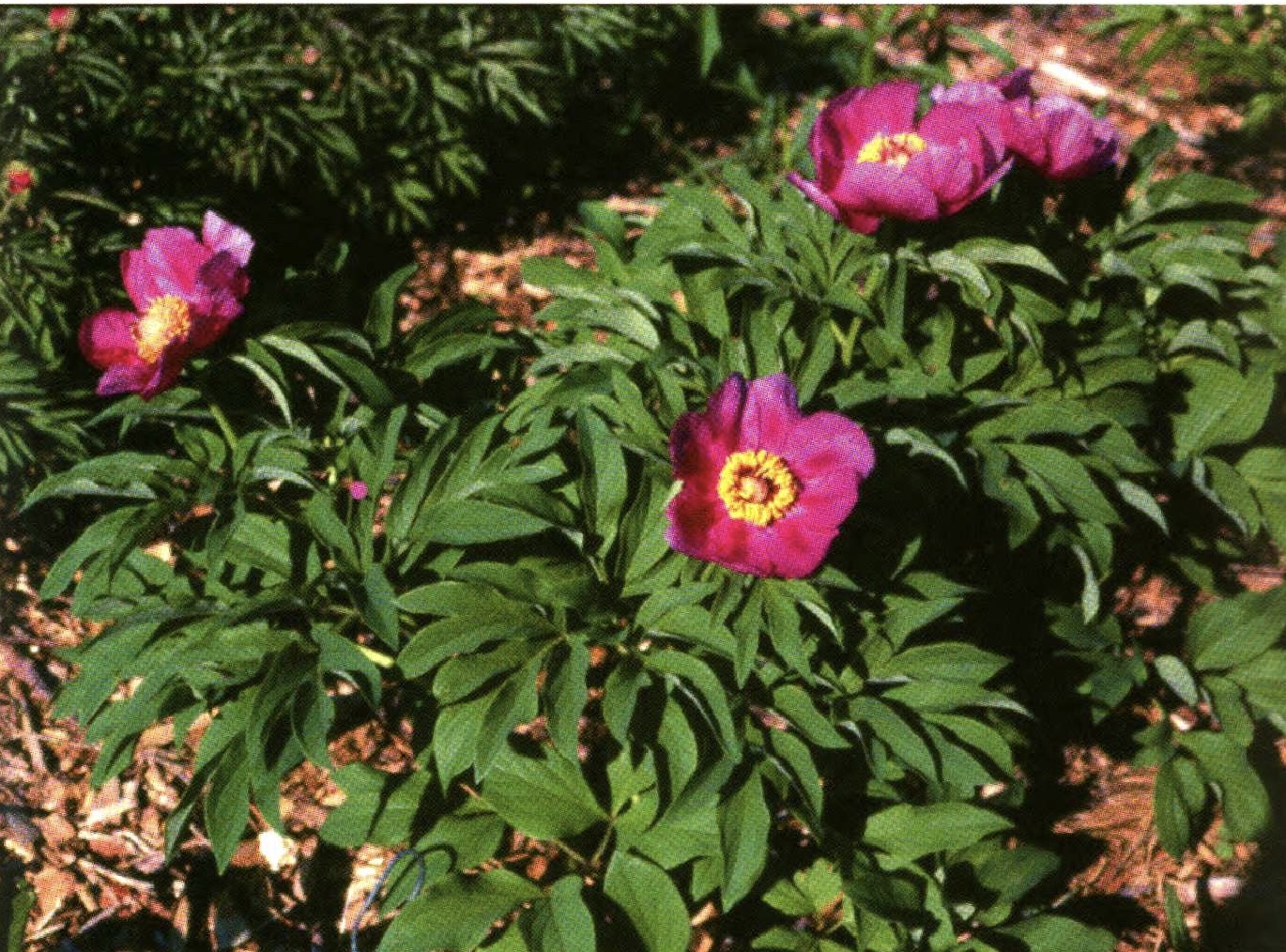
- *P. mollis (officinalis subsp. villosa) is a delightful small to medium growing plant with blue-green foliage and soft clear pink flowers. It does go dormant early with the foliage suffering with dry summer conditions. When grown in another location where irrigation was supplied during dry periods, the plant flourished and spread to a nice size colony.
Paeonia mollis
- *P. mascula is easy to grow and flower. Some forms are attractive, while others lack flower form-being more open or having a pale non-descript pink flower color. I’ve selected some with superior flower and plant forms for division and production.
- *P. mascula triternata from seed has varied considerably probably due in part to garden hybridization since the seed received through seed exchanges was from avid peony collectors that had more than one form of mascula growing in their gardens. Most often the leaves of the garden-collected seedlings tend to be more divided than the classic description for this species.
- *P. bakeri (mascula arietina) seed came from a gardener in England. It comes true from seed being somewhat more slender in habit with silvery, blue-green, narrow foliage and a more upright habit than the other forms of mascula that I grow a very subtle and beautiful plant with pleasant pink flowers. The spring foliage is unusual and somewhat silvery brown in color adding to its uniqueness.
- P. obovata has been a difficult subject for me, surviving but never thriving, although root competition or excessive shading could be more to blame than the plants. Still I’ve lost enough of this one to make me wonder if I just don’t have the right soil conditions. One that is growing in a bright less-shaded location is doing better than those that are quite shaded.
- P. japonica is represented by one seedling I planted in the garden in 2003. It is too young to comment on, except that it has (so far) lived through a particularly difficult dry fall, very cold (-25°F) winter with no snow cover until after December.
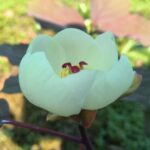
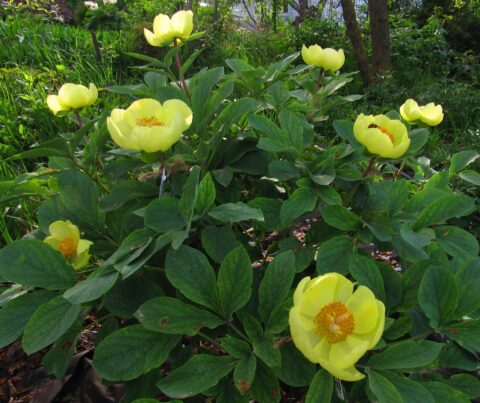
- *P. mlokosewitschii rosy sprouts give way to light-green, wavy-edged, rounded foliage and soft yellow blooms. The emerging foliage is very attractive.
- *P. (mlokosewitschii x caucasica) hybrids that have been pink to picotee-edged creamy flowers are identical in plant habit to mlokosewitschii when sprouting in the spring. After my initial disappointment in their flower color not being yellow, I’ve grown to love these plants for their wonderful spring foliage and subtle flower coloring. The flowers are fleeting, but beautiful.
- *P. caucasica (daurica) plants are easy to grow and, while the flower color is basic pink, some are darker in color. It is one of the first species to ripen its seeds, often as early as August 5th.
- *P. caucasica from wild collected seed has also produced a few white flowered forms that bloom so early its first flowers this year were injured by water freezing in the buds. This might be a natural hybrid of P. macrophylla or just P. macrophylla itself. I’ll examine it closer next year when hopefully I’ll have a better show of blooms.
- P. cambessedesii is very slow growing but persistent in my garden. I realize my growing conditions are not all that similar to its natural growing range and may make it more challenging to grow. It has not yet flowered, but I hover over the foliage in the spring as it has such beautiful foliage for a peony plant.
- *P. anomala seedlings are beloved food for cutworms while in the juvenile stage from seed. It has been a slow to very slow grower for me with one seedling taking five years to bloom. Another wild collection has yet to bloom from seed planted eight years ago. If you can’t find P. anomala, try a similar looking hybrid that is easier to grow and a dependable bloomer, such as Smouthii.
- *P. veitchii is much slower to emerge in the spring with its bronze foliage compared to other species. Its foliage also seems to suffer in full sun exposure as the plants grown in areas protected from the hottest sun show no damage to the foliage. The foliage is narrow and glossy adding interest to the garden. It flowers well with one or two flowers per stem often facing outwards instead of upwards. Quite an attractive little plant though some forms do have a more sprawling plant habit. It grows quite quickly from seed making husky plants in a few years.
- P. veitchii woodwardii is stressed in full sun in our growing fields. I should find it a shadier spot without root competition. Supposedly of smaller plant habit, I’ve seen little difference in the plants I’ve grown from seed. Perhaps I don’t have the subspecies at all, although I’ve bought mature plants and grown many from seed.
- P. veitchii Malika has been slow growing, but is still alive after two years in the semi-shaded garden.
- *P. peregrina is hands-down my favorite species for its bright red colored flower and glossy green leaves. Not difficult to grow and flower it grows best in well-drained soil in full sun. Foliage does start to mature ahead of the P. officinalis-types although not until the end of August when other plants also begin to show signs of fall foliage.
- P. peregrina banatica was wild-collected seed labeled as coming from Romania. It looks very similar in plant habit and leaf structure to the other P. peregrina I’ve grown and flowered so far. I have other P. banatica samples from different seed sources but they are so similar to the P. officinalis I have growing I’m not sure if they are true or different looking enough to warrant a space in a limited collection of species. P. banatica grown from other seed sources should bloom next season. Casual observance in the row makes it look very much like any other officinalis. It may be that this seed was from a garden collection where it may have crossed with P. officinalis.
- *P. wittmanniana holds the record for the number of years from seed to flower, which took 13 years for its first bloom. A pale appealing light yellow flower, I think it was worth the wait. The plant has always been a healthy looking specimen in the garden, but has spent all 15 years of its life on the north side of our home garage shaded in part by rhododendrons and maidenhair ferns, so perhaps with a bit more care it would no doubt perform better.
- *P. wittmanniana from what was supposed to be wild-collected seed from Kartli, Georgia is a bright pink with dark exciting flares much like Saunders’ hybrid FIRELIGHT but more distinct in that it holds the color contrast longer without fading and is not as coarse a plant as FIRELIGHT. All the seedlings of this wild-collected seed flowered pink, although the plants are nearly identical to the normal yellow flowered one grown from a different seed source.
- P. kavachensis is a small seedling from wild-collected seed and is yet to bloom but is growing well. This is referred to in Halda and Waddick’s recent publication, The Genus Paeonia, as P. daurica subsp. daurica.
- P. steveniana (P. wittmanniana subsp. macrophylla) has been difficult, with two of three seedlings lost even with fairly good size growth from three different sources. The third has gone dormant the first week in August and next spring will tell if it will emerge again or die like the other two. Curiously, they never seem to die during winter-only the summer months.
- P. tomentosa (P. wittmanniana subsp. tomentosa) seedling is still growing and gaining size, but perhaps it will take as long as P. wittmanniana did to bloom.
- P. ruprechtiana has so far survived one winter in the garden (although it was a very severe fall and early winter without snow cover and sub-zero temperatures).
- *P. lactiflora from wild-collected seed is a more delicate looking plant than the selected cultivars of this most important species. Lovely white flowers, although similar to single-flowered cultivated forms, are not as coarse in appearance.
- P. emodi grown from seed is only one year old. I saw this beautiful white-flowered species for the first time at the Botanical Garden in Vienna and have but one seedling to test outdoors this year. In early September a squirrel decided this was the seedling to dig up, bite the leaves off and cast aside the root. It was replanted but surely suffered from the trauma.
- P. mairei died the first season planted so I can’t report anything except that I hope to give it another try when I can find the plant or seed again.
- All of my P. brownii seedlings have died horrible deaths: one was stepped on by the postal deliverer cutting across the garden; another was weeded out by my wife; one was devoured by cutworms; and three rotted in the seedling flats. Alas, I have the most wonderfully drained, perfect soil one could ever imagine that bakes in the summer for this Western species of the US. I’ll try again when I can get some seed or started plants.
5. WOODY SPECIES
- *P. ostii seed from China may be from their fields of FENG DAN BAI-types, which are cultivated for medicine as some reports claim, and is nearly extinct in nature. At any rate, they are lovely plants with fantastic vibrant burgundy and hot pink fall foliage. The seedlings are very fast growing and floriferous and produce many seeds. Pale lavender coloration to the base of the white flowers, or even pure white flowers, occur in seedlings from the same seedpods. This is very cold hardy as it has survived -45°F temperatures and a very exposed garden and wide-open field locations. It has performed well in the open field with full day-long sun exposure although the flowers are not as durable as those grown alongside our driveway in partial shade beneath a huge apple tree and in our woodland garden in dappled shade. Though not as thick with foliage as the P. suffruticosa hybrids or Chinese cultivars it has matured into some very beautiful plants in the woodland garden and along the nursery entrance. I think this species should be considered a useful parent by some adventurous hybridizers for cold hardiness in tree peonies. If I could clone myself I’d love to try such a program, but the spring season is just too busy at the nursery for much controlled peony crossing.
- P. lutea ludlowii dies to the ground each winter but grows back from the crown every spring often reaching a height of five feet or more with many vigorous sprouts. It has never bloomed for me and does not seem to form dormant buds in the fall like most of the other woody species, but continues sappy growth until killed by the first hard frost. I’m nearly ready to give up on this one as I just can’t get it to bloom!
- P. lutea has not been as vigorous as delavayi seedlings and has yet to bloom. Botanists now say that it and P. delavayi are just color forms of the same species. Hans Hansen, APS Board Member and Minnesota Peony Society President has collected seed in China, and has flowered the species in Southern Minnesota.
- *P. delavayi blooms with small orange flowers on vigorous five-foot stems growing from the crown at ground level after dying back in the winter. Shady moist areas of pine forests among scrub are the reported growing habit although our plants are in full sun in a dry well-drained soil. I should try moving some of the plants to other areas of the nursery. Two-year-old seedling plants were planted in my home garden this fall.
- P. rockii, still un-bloomed from wild collected seed, are gaining in size and should bloom in a year or two. They appear healthy but do not grow as quick as P. ostii. Little or no real winter damage has been observed to date on these seedlings. Hans has also grown and flowered this species successfully in his garden.
- P. x handel-mazzetii, a natural hybrid of P. delavayi and P. lutea from seed collected by J.J. Halda, has not bloomed yet from seed sown in 2001.
- P. x franchetii, a natural hybrid of P. lutea and P. potaninii from seed collected by J.J. Halda has also survived and grown, but it too has yet to flower from seed sown in 2001.
6. GROWING SPECIES PEONIES – GOOD & BAD
They definitely have a certain charm and possess foliage and floral characters not found in the Lactiflora cultivars that we grow, although they have shared some of their charms with the hybrid peonies. Some species just do wonderfully growing in sandy well-drained soil and seem unaffected by hot dry conditions and are even adapted to going dormant. Perhaps this character we may see as a negative may prove useful as we realize a greater need to conserve water in our landscapes. For those gardeners with less than full sunshine conditions some of the species seem to perform quite well in partial shade. The woody peony species seem to tolerate root competition well. I have lost herbaceous species to competition from tree and shrub roots that took all the water and nutrients the soil could provide and moved in to surround the peony plants roots and crown. On investigating the area where the plant was lost, there was nothing but a very vigorous mass of roots from the tree or shrub surrounding the dried crown of the dead peony.
Challenges for seedlings: I’ve had mice harvest germinated seeds and eat the sprouted roots and shoots and leave the poor seed lying on top of the pots or even eat part of the seeds themselves. Slugs and cutworms have neatly mowed down seedlings germinated outdoors. Soggy soil conditions in pots have proved fatal. Too short a warm rooting period and moving to the cool cycle has stopped germination progress in its tracks. Germination in resealable plastic bags has been subject to drying out in the frost-free refrigerator that we have used. Neighboring plants shading the small seedlings can also spell disaster. Weather extremes take their toll on the small seedlings that emerge early and are frozen and heaved out of the ground by freezing and thawing cycles in the spring.
Challenges for mature plants: Excessively wet spring weather and extended periods of cold during emergence and leaf expansion provides conditions that allow botrytis to infect the plants. This fungal infection is rarely fatal, but extra care related to sanitation is necessary. Removal of infected leaf parts, keeping the weeds away from the plants and not crowding them to provide good air circulation helps. Invasive competition from tree roots can weaken and eventually kill even a mature peony. Late frosts have never killed the stems, but this past year stems did crack and provide a good wound for botrytis infection. Some flower buds that were half open at the top had rainwater settle in them and freeze the buds.
Despite these challenges I still think it is all worth it for the subtle beauty the plants and flowers bring to our spring garden. well ahead of the glorious Lactiflora bloom season. I wish you all the best of success as you give some of the “original peonies,” the species, a special place in your garden.
Notes:
|






)