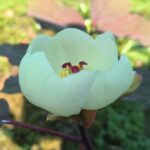
Usually growing in sparse chaparral, open places in chaparral or woods of Pinus, Picea or Populus, or on grassy slopes. The plants with which it is most frequently associated are Pinus ponderosa, Pseudotsuga menziesii, Calocedrus decurrens, Populus tremuloides, Larix sp., Castanopsis sp., Ceanotus sp. and Artemisia spp. The species mostly occurs in granite soils or on volcanic rocks at altitudes from 600 to 2,600 m. Confined to the USA and distributed in N California, Idaho, Nevada, Oregon, Utah, Washington and Wyoming.
More info
Latest articles:
-
 Our hybridizing program, 2026 2026, August 24th
-
A dike of a flower: NOP Fleur Espel (NL) 2026, August 20th
-
Long term storage of peony pollen 2026, May 6th
-
Paeonia species of Georgia 2026, January 30th
-
The best peony germinating substrate: part 2 2026, January 28th
-
The Peony in China: A Few Journeys 2026, January 27th
-
Peony Hybridizers: Rat Thierry 2026, January 22nd
-
Peony Hybridizers: Skakodub Anatoliy – Askarova Larissa 2026, January 21st
-
Peony Hybridizers: Lukoyanov Yuri 2026, January 21st
-
Peony Hybridizers: Vynogradska Elina 2026, January 20th
-
Peony Hybridizers: Kļaviņa Ritma 2026, January 19th
-
Oriental Gold: Legend, Hypothesis, and the Scientific Mystery of a Peony 2026, January 19th
-
Peonies in China and the Netherlands 2026, January 19th
-
Paeonia x kayae 2026, January 19th
-
Peony Hybridizers: Hurtekant Koen 2026, January 16th
-
Peony Hybridizers: Anokhin Petr 2026, January 15th
-
Peony Hybridizers: Khorosh Igor 2026, January 14th
-
Peony Hybridizers: Kaya Erdal 2026, January 13th
-
Peony Hybridizers: Otto-Zagorska Ilga 2026, January 12th
-
Peony Hybridizers: Gorobets Vasyl 2026, January 8th