A peony with wonderful flowers, but the stems are far too weak unfortunately.


A peony with wonderful flowers, but the stems are far too weak unfortunately.
Al Rogers was named after the American nurseryman who wrote an excellent book about peonies. It is an outstanding...
Both Early and Late Windflower have been growing here for several years. As many will know, they are extremely...
Cool flowers from the Land of the Midnight Sun. Article by Pat Holloway.
 Where Did Yellow Itoh Peonies Get Their Colour? 2026, October 14th
 Paeonia japonica, the Japanese woodland peony 2026, October 8th
 The reticulate evolution and hybridization of herbaceous peonies 2026, October 7th
 Our hybridizing program, 2026 2026, August 24th
 A dike of a flower: NOP Fleur Espel (NL) 2026, August 20th
 Long term storage of peony pollen 2026, May 6th
 Paeonia species of Georgia 2026, January 30th
 The best peony germinating substrate: part 2 2026, January 28th
 The Peony in China: A Few Journeys 2026, January 27th
 Peony Hybridizers: Rat Thierry 2026, January 22nd
 Peony Hybridizers: Skakodub Anatoliy – Askarova Larissa 2026, January 21st
 Peony Hybridizers: Lukoyanov Yuri 2026, January 21st
 Peony Hybridizers: Vynogradska Elina 2026, January 20th
 Peony Hybridizers: Kļaviņa Ritma 2026, January 19th
 Oriental Gold: Legend, Hypothesis, and the Scientific Mystery of a Peony 2026, January 19th
 Peonies in China and the Netherlands 2026, January 19th
 Paeonia x kayae 2026, January 19th
 Peony Hybridizers: Hurtekant Koen 2026, January 16th
 Peony Hybridizers: Anokhin Petr 2026, January 15th
 Peony Hybridizers: Khorosh Igor 2026, January 14th
 Prairie Peonies HortAlaska Peonies
2026, The Peony Society
Widely distributed from the Iberian Peninsula to the Balkans via France, Italy and Switzerland.
More info
Growing in bushes and grasslands, but also in open woods, at altitudes from lowlands to 2,300 m, but to 3,400 m in Sichuan Province (Kangding), China. In E Asia: China, the Korea Peninsula, E Mongolia, and Russia (the Far East and SE Siberia).
The most distinct character of Paeonia lactiflora is the cartilaginous thickening along the leaf margins, which are dentate—spinose on these thickenings.
More info
Seedling “Seidl L-q”. Parentage unknown. First bloomed 1965. DOUBLE. White. Opens soft pink but quickly fades to white. Five inch flowers (13 cm), three per stem. Average of 5 smooth green carpels. Has stamens and pollen. Sturdy growth, flowers well supported on 28 inch stems. Typical lactiflora foliage, dark green. Blooms early midseason. Named for Allan Rogers, peony nurseryman and author (with permission).
Perennial, any plant that persists for several years, usually with new herbaceous growth from a part that survives from growing season to growing season
Seedling number not known. Parentage: Mons. Jules Elie x Mlokosewitschi. This variety represents the only successful cross ever made, using lactiflora, x Mlokosewitschi. It is true light creamy yellow single. Its guard petals are well rounded and crinkled and form a large cupped flower of great beauty. Its filaments are yellow supporting orange colored anthers, which are usually numerous. It sets abundant seed. It has hairy white carpels and light pink stigmas. The stems are about 28 inches tall and are thin, but stiff. Its foliage is pink in the Spring. It is a vigorous grower and has excellent plant habit.
35". Single. Clear pink, big flowers, a bit crinkled and mottled, 6 inches wide. Average number of flowers, big heavy long bright golden stamens. Near white pistils have red tops. Fairly dense plant, big leaves, flowers carried high above bush.
Award of Landscape Merit (ALM) description: 'Roselette' (Saunders, 1950) Herbaceous Hybrid, Very early, 36?, Strong scent — Second generation hybrid descended from P. lactiflora, P. mlokosewitschi and P. tenuifolia; single. For those chomping at the bit each spring, 'Roselette' is prized for its early blooms that usher in the season of full size peonies. Each warm pink bloom is cupped and crinkled, consisting of nine or ten petals with occasional hairline streaks of cool red running their length along vein lines. A feather flare of light pink is evident on the backside of the petals. Stamen filaments are lighter and more lemon in color than the stamens. Carpels are light lemon green and tipped deep red. Erect stems hold blooms high above the bush. Mature blooms remain attractive withstanding early spring winds. Light green foliage is dense and, if Roselette is well situated and watered, durable all season, a legacy of its big-leafed peony heritage, P. macrophylla. A model of health above ground, so too 'Roselette' is below, with unearthed six-year old plants showing no evidence of root rot. Establishes and increases stem count quickly. Propagates readily by division, yielding superior “wagon wheel” type bare roots, attached to three–five eyed crown. Also propagates by adventitious roots. Suitable for landscape only.
(officinalis rubra x lactiflora} A sensation at recent peony shows. Perfect double bomb type, rich red collar of big petals, full and sturdy plant, no stamens, rather long pale green pistils.
From the Dutch peony testing series in 1998((footnote: Kortmann, J. "Paeonia: pioen." In: Dendroflora, 1998, vol 35, pp 58-95.)), own translation:
'Red Charm' (Glasscock, USA, 1944) (P. lactiflora x P. officinalis) Flowers dark red, very large, double, centre filled with many deep red petaloids, surrounded by two circles of large petals; leaves rather large, dull green; upperside somewhat irregular; height 100 cm; stems rather sturdy; number of stems mediocre. This American cultivar is remarkable thanks to its magnificent colour and the enormously large flowers, which need support to remain upright, despite the plant having sturdy stems. The mediocre number of stems and the development of so called 'necks' on the roots inhibited propagation and distribution at large scale for some time. 'Red Charm' is reportedly somewhat susceptible toward botrytis, which was also noted by the review commission. It is a good garden plant, despite some negative characteristics.
Very dark red Jap. Good upright grower, vigorous, late, 34 inches. An improvement on Fuyajo. Seedling # JE-3.
Award of Landscape Merit (ALM) description: 'Charm' (Franklin, 1931) Lactiflora Group, Late mid-season, 38? — A lustrous and satiny, dark red Japanese form bloom with a center of the same red petaloids, etched yellow. Stiff and relatively straight stems angle outward gracefully to form a very large, harmoniously mounded, fountain of blooms. An eight-year-old plant matures to 40 or so stems that emerge from a relatively compact area. Although individual blooms are at their peak for a shorter duration than those of other lactifloras, plenty of side buds help 'Charm' maintain its striking presence in the landscape. One of the later Japanese form peonies to bloom.
Seedling TF-8. Parentage: (P. tenuifolia 'Plena' x P. tenuifolia 'Rosea')F2. First bloomed 2012, first propagated 2013. Fully double BOMB form. Baby pink flowers are borne 1 to a stem, 3¼ inches (8 cm) in size, up facing to slightly out facing. Two to three carpels on average which are glabrous to slightly tomentose, green and topped with whitish stigmas, the latter sometimes deformed. Disc poorly developed. No pollen, but as a pod parent normally fertile but not with other pink P. tenuifolia, so far. Not fragrant. Blooming time very early, together with or slightly ahead of P. tenuifolia 'Plena'. Finely cut foliage, pale green on emergence, is typical of the species. Average height to 15 inches (38 cm); support not needed. Named after originator's mother who was not the tallest person but the best mother one can imagine.

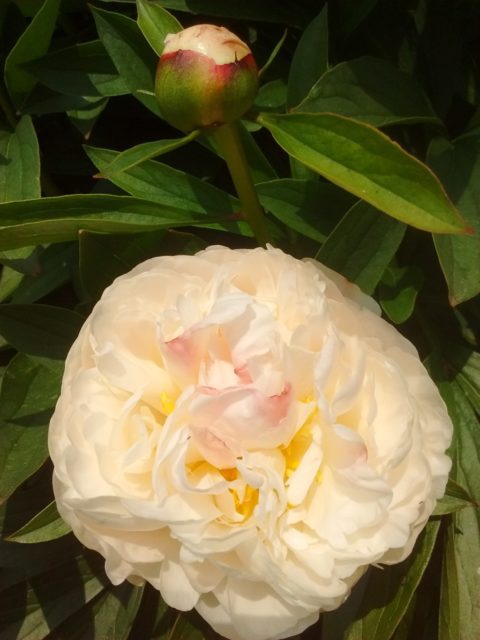





White Vanguard has, by benign accident, been distributed as two different seedlings as noted by Ruud. They possess two different parentage accordingly. #79H14-1 is the true White Vanguard, an Archangel seedling, that I acquired from Bill Seidl over a dozen years ago. It blooms very early, concurrent with the last blooms of Claire de Lune, has warm tints upon first opening and stands well without mechanical support. I was unsuccessful in trying to post a picture here, but have posted images of a newly opened bloom and the bush of #79H14-1 on my Facebook page Chotkowski Gardens for those who are interested.
From Chotkowski Gardens on facebook: Flowering time: Very early, concurrent with the last opening blooms of Claire de Lune, a bit before Roselette, before Archangel, way before Red Charm.
#79H14-1 does indeed look better than the White Vanguard I have, thanks for the info Ruud and Henry
Seidl seedling# 79H14-1 or 79H5-7?