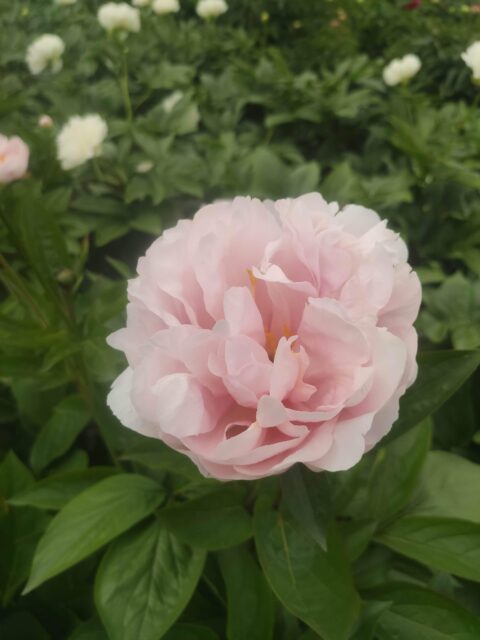
A peony with wonderful flowers, but the stems are far too weak unfortunately.


A peony with wonderful flowers, but the stems are far too weak unfortunately.
Both Early and Late Windflower have been growing here for several years. As many will know, they are extremely...
Our favorite Paeonia species, Paeonia mascula ssp. hellenica is a short growing plant with outstanding foliage and extremely pretty...
Ballerina is a peony bred by A.P. Saunders in 1941 from the cross Wittmanniana x Lactiflora ‘Lady Alexandra Duff’....
From Mallorca (Balearic Islands in the Mediterranean Sea) comes P. cambessedessii. Although it is sometimes offered by peony nurseries,...

 Where Did Yellow Itoh Peonies Get Their Colour? 2026, October 14th
 Paeonia japonica, the Japanese woodland peony 2026, October 8th
 The reticulate evolution and hybridization of herbaceous peonies 2026, October 7th
 Our hybridizing program, 2026 2026, August 24th
 A dike of a flower: NOP Fleur Espel (NL) 2026, August 20th
 Long term storage of peony pollen 2026, May 6th
 Paeonia species of Georgia 2026, January 30th
 The best peony germinating substrate: part 2 2026, January 28th
 The Peony in China: A Few Journeys 2026, January 27th
 Peony Hybridizers: Rat Thierry 2026, January 22nd
 Peony Hybridizers: Skakodub Anatoliy – Askarova Larissa 2026, January 21st
 Peony Hybridizers: Lukoyanov Yuri 2026, January 21st
 Peony Hybridizers: Vynogradska Elina 2026, January 20th
 Peony Hybridizers: Kļaviņa Ritma 2026, January 19th
 Oriental Gold: Legend, Hypothesis, and the Scientific Mystery of a Peony 2026, January 19th
 Peonies in China and the Netherlands 2026, January 19th
 Paeonia x kayae 2026, January 19th
 Peony Hybridizers: Hurtekant Koen 2026, January 16th
 Peony Hybridizers: Anokhin Petr 2026, January 15th
 Peony Hybridizers: Khorosh Igor 2026, January 14th
 Prairie Peonies HortAlaska Peonies
2026, The Peony Society
First bloomed 2006 from seeds collected 2002, first propagated 2007. Parentage; 'Lavender' open pollinated. Has had limited distribution since 2009 to breeders, and a few others, as 'Lavender Baby'. Early bloom season (6 days before 'Red Charm' in 2012). One flower per stem, flower size 5 inches (13 cm). No fragrance. Flowers are single, colored dark lavender, approaching purple tones. Carpels are light green, 3 on average, with dark purple stigmas. Filaments are the same color as the petals at the base, fading to near white at the tips. Has pollen and readily makes seeds under open pollination and also when crossed with tetraploids. Foliage with strongly divided narrow leaflets, grey-green color, with a matte finish. Average height at maturity 18 inches (45 cm).
Parentage: Blushing Princess x Salmon Dream. Blushing Princess is an F2 from P. lactiflora x Gwenda. Gwenda is an F2 from P. tenuifolia x P. mlokosewitschii. Salmon Dream is from Paula Fay x Moonrise. Paula Fay is from P. lactiflora x P. peregrina. Moonrise is an F2 from (another) P. lactiflora x P. peregrina. So Pink Vanguard has 4 species in its ancestry.
Seidl seedling number H-17. Early-Early Midseason, light milky pink, cupped Semi-double flower on a strong growing plant. Long, broad guard petals surround several rows of smaller inner petals having excellent substance, and stamens. Flower resists late freeze damage. Medium tall (40 inches) and erect, the plant is clothed in large blue-green leaflets. Side buds extend flowering. Seeds and pollen, parent of wanted forms.
Relatively widely distributed, from N Spain (Cantabria and Soria) to Iraq via France, Italy, the Balkans, Cyprus and Turkey.
More info
Double type; large; midseason. Blooms are borne in clusters, with smaller, saucer-shaped side flowers; pale blush-pink, almost white, with yellow stamens mixed with a few irregular petals in the center; fair fragrance. Medium height; very floriferous; stems strong. Foliage abundant. In some seasons it is decidedly pink, especially on the back of the blooms near the calyx. As usually seen, the flowers are charming and informal and the plant is very graceful. “Terminal flowers on established plants are well filled out. A first-class exhibition bloom, and one of the most beautiful of all peonies.”—Saunders. “A first-class exhibition bloom. The laterals, if not disbudded, will produce semi-double flowers.”—Thurlow. “Often one of our greatest show peonies.”—Brand.
Seedling 16350 F2. Hybrid, blush pink, semi-double. It has stamens, pollen and seeds. Most reliable. Excellent substance, 32" in height. Fragrant, early to midseason bloom. Large medium green foliage. Sometimes the flower has so many petaloids in the center that it is close to double. This seedling came via the Reath Nursery. It was named by David Reath and registerd by Caprice Farm Nursery, August 15, 1991.
Growing in bushes and grasslands, but also in open woods, at altitudes from lowlands to 2,300 m, but to 3,400 m in Sichuan Province (Kangding), China. In E Asia: China, the Korea Peninsula, E Mongolia, and Russia (the Far East and SE Siberia).
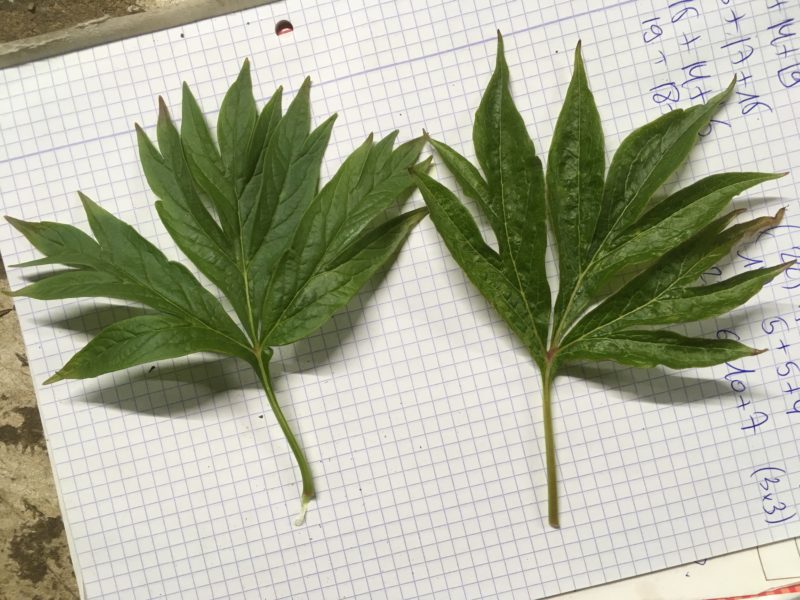
The most distinct character of Paeonia lactiflora is the cartilaginous thickening along the leaf margins, which are dentate—spinose on these thickenings.
More info
(Lemoine, 1905) Hybrid. (albiflora x Wittmanniana) white
(Lemoine, 1907) Hybrid. (albiflora x Wittmanniana) light pink
Herbaceous hybrid. Lacti x wittmanniana. White with yellow and green tints.
(wittmanniana x Lady Alexandra Duff). Large double bomb, delicate greenish yellow tinted with pink, earlier than Seraphim.
Herbaceous hybrid. Single. Lacti x wittmanniana. White with green tints.
Without hairs.
a leaf is 'segmented' when it consists of pieces of various shapes, which are more or less separated from one another
carpel: an organ at the centre of a flower, bearing one or more ovules and having its margins fused together or with other carpels to enclose the ovule in an ovary, and consisting also of a stigma and usually a style.
[caption id="attachment_29279" align="alignleft" width="476"]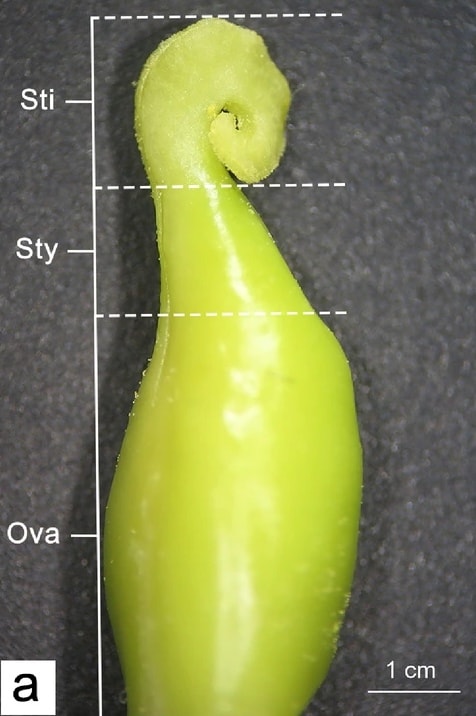 Carpel of P. ludlowii, showing ovary, style and stigma[/caption]
Seedling number not known. Parentage: Mons. Jules Elie x Mlokosewitschi. This variety represents the only successful cross ever made, using lactiflora, x Mlokosewitschi. It is true light creamy yellow single. Its guard petals are well rounded and crinkled and form a large cupped flower of great beauty. Its filaments are yellow supporting orange colored anthers, which are usually numerous. It sets abundant seed. It has hairy white carpels and light pink stigmas. The stems are about 28 inches tall and are thin, but stiff. Its foliage is pink in the Spring. It is a vigorous grower and has excellent plant habit.
35". Single. Clear pink, big flowers, a bit crinkled and mottled, 6 inches wide. Average number of flowers, big heavy long bright golden stamens. Near white pistils have red tops. Fairly dense plant, big leaves, flowers carried high above bush.
Award of Landscape Merit (ALM) description: 'Roselette' (Saunders, 1950) Herbaceous Hybrid, Very early, 36?, Strong scent — Second generation hybrid descended from P. lactiflora, P. mlokosewitschi and P. tenuifolia; single. For those chomping at the bit each spring, 'Roselette' is prized for its early blooms that usher in the season of full size peonies. Each warm pink bloom is cupped and crinkled, consisting of nine or ten petals with occasional hairline streaks of cool red running their length along vein lines. A feather flare of light pink is evident on the backside of the petals. Stamen filaments are lighter and more lemon in color than the stamens. Carpels are light lemon green and tipped deep red. Erect stems hold blooms high above the bush. Mature blooms remain attractive withstanding early spring winds. Light green foliage is dense and, if Roselette is well situated and watered, durable all season, a legacy of its big-leafed peony heritage, P. macrophylla. A model of health above ground, so too 'Roselette' is below, with unearthed six-year old plants showing no evidence of root rot. Establishes and increases stem count quickly. Propagates readily by division, yielding superior “wagon wheel” type bare roots, attached to three–five eyed crown. Also propagates by adventitious roots. Suitable for landscape only.
(officinalis rubra x lactiflora} A sensation at recent peony shows. Perfect double bomb type, rich red collar of big petals, full and sturdy plant, no stamens, rather long pale green pistils.
From the Dutch peony testing series in 1998((footnote: Kortmann, J. "Paeonia: pioen." In: Dendroflora, 1998, vol 35, pp 58-95.)), own translation:
'Red Charm' (Glasscock, USA, 1944) (P. lactiflora x P. officinalis) Flowers dark red, very large, double, centre filled with many deep red petaloids, surrounded by two circles of large petals; leaves rather large, dull green; upperside somewhat irregular; height 100 cm; stems rather sturdy; number of stems mediocre. This American cultivar is remarkable thanks to its magnificent colour and the enormously large flowers, which need support to remain upright, despite the plant having sturdy stems. The mediocre number of stems and the development of so called 'necks' on the roots inhibited propagation and distribution at large scale for some time. 'Red Charm' is reportedly somewhat susceptible toward botrytis, which was also noted by the review commission. It is a good garden plant, despite some negative characteristics.
Very dark red Jap. Good upright grower, vigorous, late, 34 inches. An improvement on Fuyajo. Seedling # JE-3.
Award of Landscape Merit (ALM) description: 'Charm' (Franklin, 1931) Lactiflora Group, Late mid-season, 38? — A lustrous and satiny, dark red Japanese form bloom with a center of the same red petaloids, etched yellow. Stiff and relatively straight stems angle outward gracefully to form a very large, harmoniously mounded, fountain of blooms. An eight-year-old plant matures to 40 or so stems that emerge from a relatively compact area. Although individual blooms are at their peak for a shorter duration than those of other lactifloras, plenty of side buds help 'Charm' maintain its striking presence in the landscape. One of the later Japanese form peonies to bloom.
Seedling TF-8. Parentage: (P. tenuifolia 'Plena' x P. tenuifolia 'Rosea')F2. First bloomed 2012, first propagated 2013. Fully double BOMB form. Baby pink flowers are borne 1 to a stem, 3¼ inches (8 cm) in size, up facing to slightly out facing. Two to three carpels on average which are glabrous to slightly tomentose, green and topped with whitish stigmas, the latter sometimes deformed. Disc poorly developed. No pollen, but as a pod parent normally fertile but not with other pink P. tenuifolia, so far. Not fragrant. Blooming time very early, together with or slightly ahead of P. tenuifolia 'Plena'. Finely cut foliage, pale green on emergence, is typical of the species. Average height to 15 inches (38 cm); support not needed. Named after originator's mother who was not the tallest person but the best mother one can imagine.


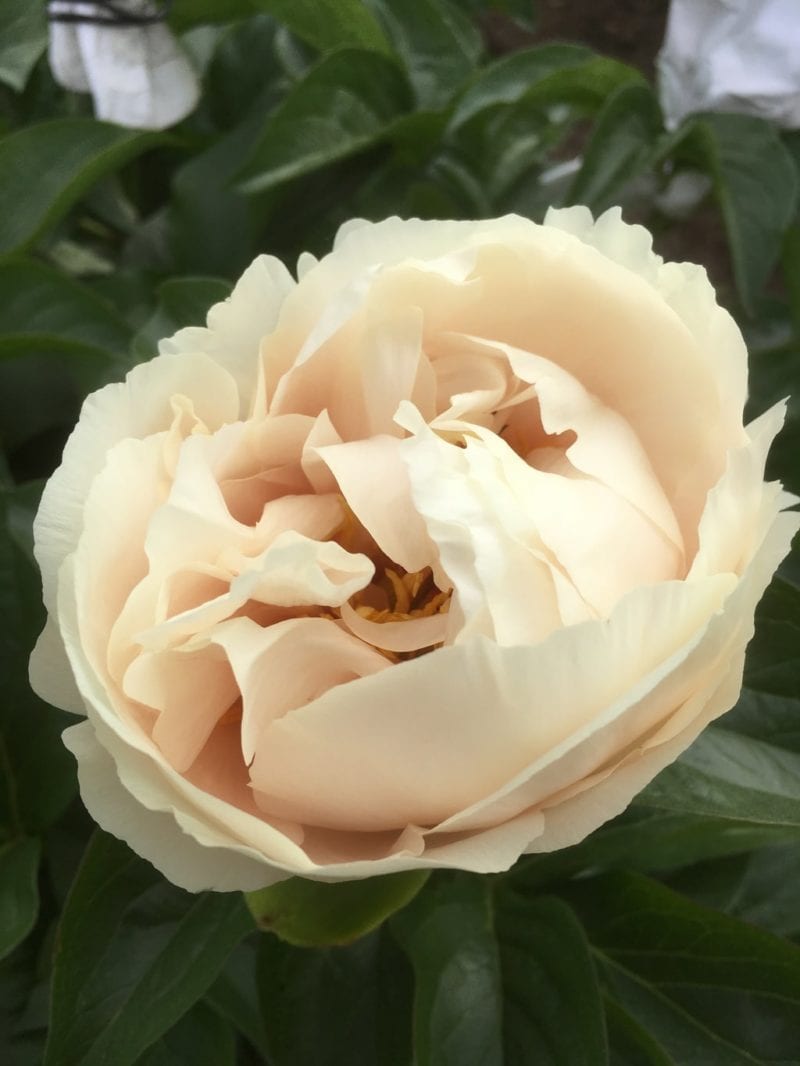


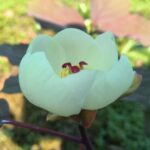


White Vanguard has, by benign accident, been distributed as two different seedlings as noted by Ruud. They possess two different parentage accordingly. #79H14-1 is the true White Vanguard, an Archangel seedling, that I acquired from Bill Seidl over a dozen years ago. It blooms very early, concurrent with the last blooms of Claire de Lune, has warm tints upon first opening and stands well without mechanical support. I was unsuccessful in trying to post a picture here, but have posted images of a newly opened bloom and the bush of #79H14-1 on my Facebook page Chotkowski Gardens for those who are interested.
From Chotkowski Gardens on facebook: Flowering time: Very early, concurrent with the last opening blooms of Claire de Lune, a bit before Roselette, before Archangel, way before Red Charm.
#79H14-1 does indeed look better than the White Vanguard I have, thanks for the info Ruud and Henry
Seidl seedling# 79H14-1 or 79H5-7?