This is a video from Down Under by the ABC television series Gardening Australia. Ron Boekel, an Australian peony grower, tells about his plants, and he does it with passion.
You can view the original video and read the accompanying article here.
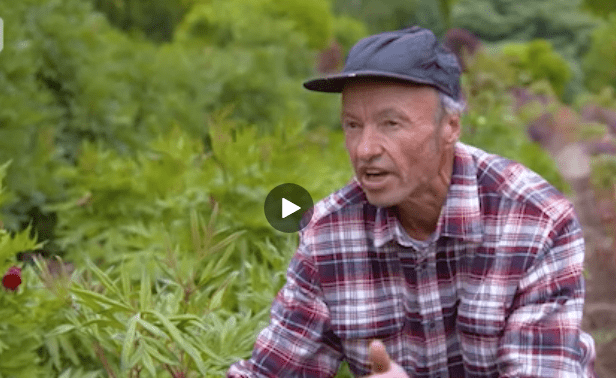
This is a video from Down Under by the ABC television series Gardening Australia. Ron Boekel, an Australian peony grower, tells about his plants, and he does it with passion.
You can view the original video and read the accompanying article here.
A lecture from A.P. Saunders, legendary peony hybridizer, in 1924 on the growing of peonies.
In the 19th century many peonies were bred in France and the UK, whilst the center of peony hybridizing...

 Paeonia japonica, the Japanese woodland peony 2026, October 8th
 The reticulate evolution and hybridization of herbaceous peonies 2026, October 7th
 Our hybridizing program, 2026 2026, August 24th
 A dike of a flower: NOP Fleur Espel (NL) 2026, August 20th
 Long term storage of peony pollen 2026, May 6th
 Paeonia species of Georgia 2026, January 30th
 The best peony germinating substrate: part 2 2026, January 28th
 The Peony in China: A Few Journeys 2026, January 27th
 Peony Hybridizers: Rat Thierry 2026, January 22nd
 Peony Hybridizers: Skakodub Anatoliy – Askarova Larissa 2026, January 21st
 Peony Hybridizers: Lukoyanov Yuri 2026, January 21st
 Peony Hybridizers: Vynogradska Elina 2026, January 20th
 Peony Hybridizers: Kļaviņa Ritma 2026, January 19th
 Oriental Gold: Legend, Hypothesis, and the Scientific Mystery of a Peony 2026, January 19th
 Peonies in China and the Netherlands 2026, January 19th
 Paeonia x kayae 2026, January 19th
 Peony Hybridizers: Hurtekant Koen 2026, January 16th
 Peony Hybridizers: Anokhin Petr 2026, January 15th
 Peony Hybridizers: Khorosh Igor 2026, January 14th
 Peony Hybridizers: Kaya Erdal 2026, January 13th
 Prairie Peonies HortAlaska Peonies
2026, The Peony Society
Widely distributed from the Iberian Peninsula to the Balkans via France, Italy and Switzerland.
More info
Growing in bushes and grasslands, but also in open woods, at altitudes from lowlands to 2,300 m, but to 3,400 m in Sichuan Province (Kangding), China. In E Asia: China, the Korea Peninsula, E Mongolia, and Russia (the Far East and SE Siberia).
The most distinct character of Paeonia lactiflora is the cartilaginous thickening along the leaf margins, which are dentate—spinose on these thickenings.
More info
Usually growing in steppes, meadows, open sandy dunes, shrubs, or at the edges of forests. Paeonia tenuifolia seems to prefer dry habitats, and was found growing at lowlands below an altitude of 900 m. Armenia, Azerbaijan, Bulgaria, Georgia, Romania, Russia (the Caucasus), Serbia, Turkey (European part) and Ukraine.
Paeonia tenuifolia as circumscripted here is a very distinct species. It has the finest leaflets/leaf segments and the greatest number of leaflets/leaf segments of any peony species.
More info
Growing mostly in deciduous broad-leaved forests, pine forests or mixed forests, less frequently in grasses. The species prefers calcarious soils and is found usually at altitudes from 50 to 1,500 m. Albania, Bulgaria, Greece, Italy (Mt San Donato di Ninea), Macedonia, Moldova, Romania, Serbia and Turkey.
The most distinct character of Paeonia peregrina is its always teeth-lobed leaflets or segments, which distinguish it readily from P. officinalis and P. saueri. The other distinct characters are tuberous or fusiform lateral roots, leaflets or segments often with bristles along veins on the upper surface, and dark-red and cup-shaped corollas.
More info
Relatively widely distributed, from N Spain (Cantabria and Soria) to Iraq via France, Italy, the Balkans, Cyprus and Turkey.
More info
Itoh hybrid, semi-double. Seedling #A81-13. First bloomed 1985. Parentage, white lactiflora dbl. x Reath hybrid tree. White with lavender cast and lavender flares. This Itoh hybrid has a flat form, stamens and pollen, that is somewhat fertile. It has prod
Having the figure of an egg
Very dark red Jap. Good upright grower, vigorous, late, 34 inches. An improvement on Fuyajo. Seedling # JE-3.
Award of Landscape Merit (ALM) description: 'Charm' (Franklin, 1931) Lactiflora Group, Late mid-season, 38? — A lustrous and satiny, dark red Japanese form bloom with a center of the same red petaloids, etched yellow. Stiff and relatively straight stems angle outward gracefully to form a very large, harmoniously mounded, fountain of blooms. An eight-year-old plant matures to 40 or so stems that emerge from a relatively compact area. Although individual blooms are at their peak for a shorter duration than those of other lactifloras, plenty of side buds help 'Charm' maintain its striking presence in the landscape. One of the later Japanese form peonies to bloom.
Seedling TF-8. Parentage: (P. tenuifolia 'Plena' x P. tenuifolia 'Rosea')F2. First bloomed 2012, first propagated 2013. Fully double BOMB form. Baby pink flowers are borne 1 to a stem, 3¼ inches (8 cm) in size, up facing to slightly out facing. Two to three carpels on average which are glabrous to slightly tomentose, green and topped with whitish stigmas, the latter sometimes deformed. Disc poorly developed. No pollen, but as a pod parent normally fertile but not with other pink P. tenuifolia, so far. Not fragrant. Blooming time very early, together with or slightly ahead of P. tenuifolia 'Plena'. Finely cut foliage, pale green on emergence, is typical of the species. Average height to 15 inches (38 cm); support not needed. Named after originator's mother who was not the tallest person but the best mother one can imagine.