Systematics and Bioecology of Peony (Paeonia L.) Species Distributed in Georgia
Bachelor’s Thesis by Gurami Abesadze
Supervisors: Shamil Shetekauri, Associate Professor & Nino Eradze, Doctor of Agriculture
Georgia, Tbilisi 2013
We are of the opinion that the people best placed to describe local species are botanists that actually live there. Georgia is one of the countries with a lot of wild Paeonia species (just like Turkey, Greece and Italy). Mr. Gurami Abesadze has written a nice paper about them, with a good key to know what species you’re looking at and some excellent descriptions. For no small part this was based upon previous work done by Kemularia Nathadze (Kemularia-Nathadze L.M. “The Caucasian Representative of the Genus Paeonia.” Trudy Tiflis. Botan. 1961.) The text was translated with the help of Google Gemini, which we consider better than google translate.
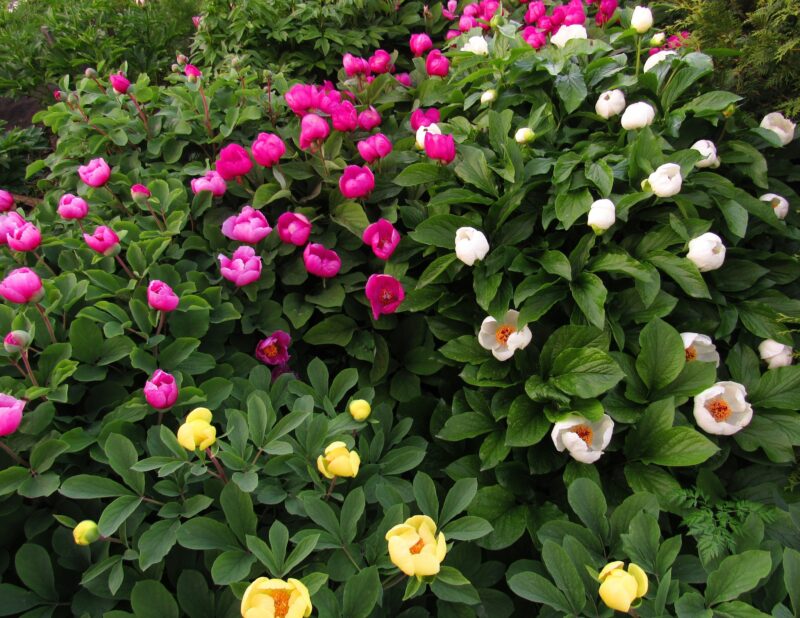
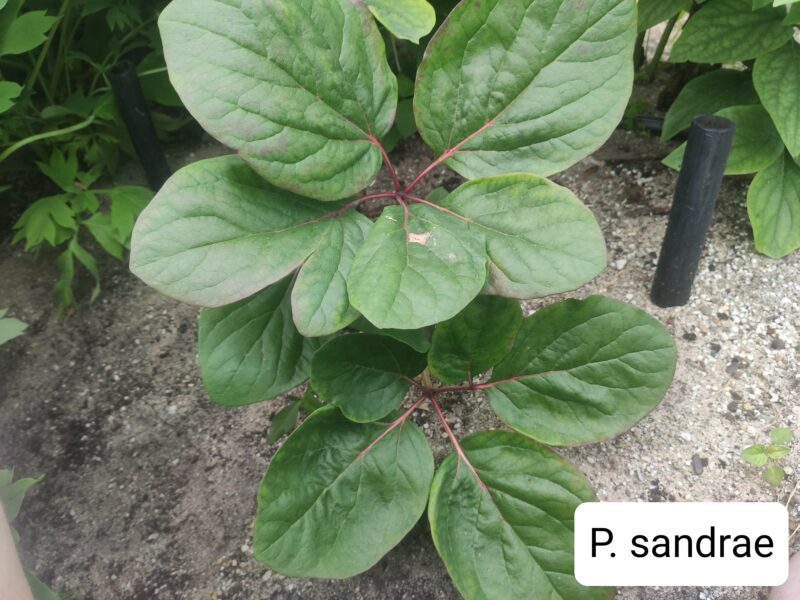
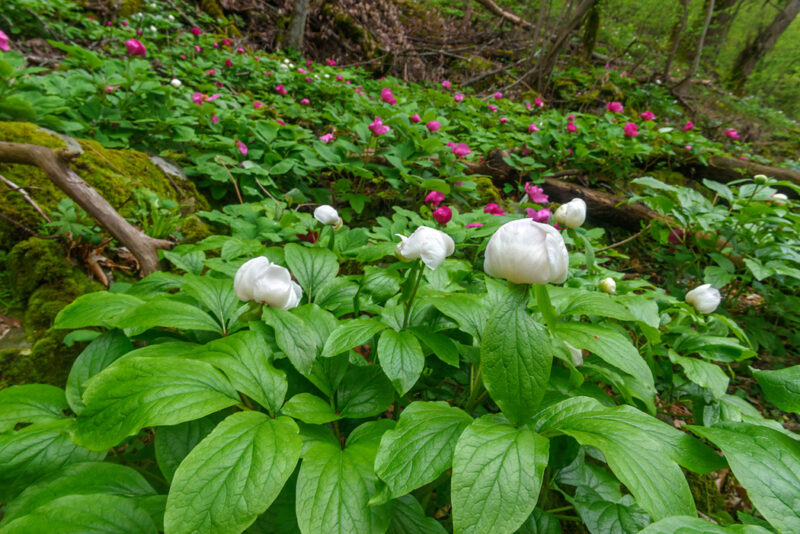
Nothing is ever perfect, so… The images accompanying the species descriptions are not always what they should be, especially within the group macrophylla – steveniana – wittmanniana (i.e. without detail, and we think in this specific group sometimes wrong). We suggest having a look at another article on this site about peonies from the Caucausus and Iran, but there the detailed descriptions are missing. The classification of the species follows Kemularia-Nathadze, but that classification according to color of the flowers is done by nobody nowadays and is best forgotten.
Some (sub)species are currently known otherwise or considered natural hybrids (aka nothospecies). Quite often we do not agree with current nomenclature (Plants of the World Online), but feel free to disagree with us:
- P. x majko is a natural hybrid (P. tenuifolia x P. caucasica)
- P. carthalinica is nowadays considered synonymous with P. tenuifolia, but we think this could be a subspecies as well
- P. ruprechtiana is nowadays considered synonymous with P. caucasica; we are unsure whether these are simply specimens with darker leaflets or if there is indeed a separate population
- P. x lagodechiana is a natural hybrid (P. caucasica x P. mlokosewitschii)
- P. caucasica is officially known as P. daurica ssp coriifolia; let’s keep it P. caucasica as (1) it clearly gives the location where it grows and (2) is used by local people
- P. steveniana is sometimes considered synonymous with P. macrophylla; the differences are subtle but we prefer to keep it separate
- P. mlokosewitschii is officially known as P. daurica ssp mlokosewitschii, which clearly is wrong, keep it separate
- P. wittmanniana and P. macrophylla are both officially known as subspecies to P. daurica, let’s not do that either.
Introduction
Our bachelor’s thesis concerns the systematics and bioecological analysis of the genus Peony (Paeonia) distributed in Georgia. The object of study was the Living Flora Department of the Tbilisi Botanical Garden. The living flora collections of this department include all species of the genus Peony found in Georgia.
Research Methodology
We conducted observations of the peony species at the collection plot of the Living Flora Department of the Tbilisi Botanical Garden every 10 days. The observations involved studying the germination, budding, flowering, and fruiting periods of each species. Each phenorhythmic phase was recorded with a camera and is presented in the bachelor’s thesis.
Plant identification and the collection of other bioecological data were carried out according to the second edition of the Flora of Georgia, Volume II (1973, pp. 8-20) and the Identification Guide to the Plants of Georgia, Volume I (1964, pp. 61-62).
Paeoniaceae Rudolph
Peonies
1. Family Characteristics
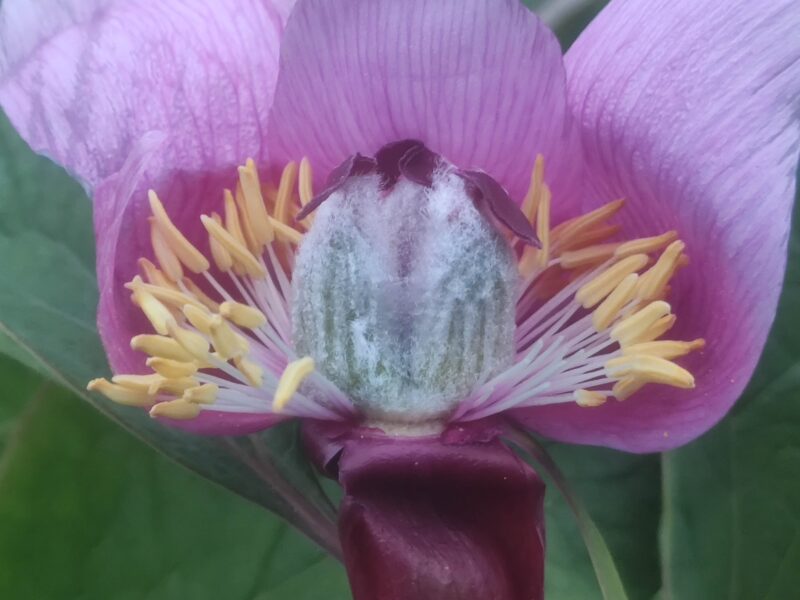
The flower is actinomorphic with a double perianth. Sepals are leaf-like, highly unequal, and, like the petals, arranged spirally. Stamens are numerous and free. Carpels are free, numbering 2-5 (10); the ovary is superior, and the stigma is flat, fleshy, and colored. The fruit is a follicle, initially fleshy, later with a heavily lignified outer pericarp. The seed has a fleshy appendage (aril); the outer integument of the ovule is longer than the inner one. These are large perennial herbs or shrubs (some Japanese and Chinese species) with alternate, bi-ternate or tri-ternate dissected leaves.
Note: The independence of the family Paeoniaceae was established as early as 1830 by the German botanists Rudolph and Bartling under the name “Ordo”; the English botanist Worsdell first used the family name in 1908. Among Soviet botanists, this view is shared by Kemularia-Natadze (1948-1958), Takhtajan (1952-1954), and Yakovlev (1955). Takhtajan and the Japanese botanist Nakai (1966) consider this family in a separate order. However, the majority subordinate it to the buttercup family (Ranunculaceae) as a subfamily or tribe. Nevertheless, in addition to morphological traits, anatomical, cytological, embryological, and biochemical data—and finally, the study of pollen grains—have confirmed the correctness of its classification as a separate family (see Kemularia-Natadze, 1958, 1963, 1966).
The family is represented by a single genus and 45 species, distributed across the mountainous regions of the Caucasus, Asia, Europe, and North America.
2. Genus Paeonia L. – Identification Guide for Peonies
Paeoniaceae (Benth. Et Hook.) Kem.-Nath.
The flower is solitary and large; the sepals are persistent (do not fall off for a long time during fruiting) and leaf-like; often, the lower sepal resembles the segments of the upper stem leaves. The petals are large, yellow, whitish-yellow, purple-red, red, or pink. Stamens are numerous and free; filaments are free, long, and colored; anthers are yellow or orange. The ovary is either glabrous (smooth) or tomentose (densely fuzzy). The fruit is large, oblong, obliquely spreading or pendulous, more rarely short, ovoid or oval, and nearly straight. Seeds are fleshy, black, bluish-black, or red. Pollen grains are nearly spherical, tricolpate, with a pore-like zone in the middle of each furrow; the exine surface is nearly smooth with a finely reticulate pattern; the diameter of the pollen grains is 28-48 microns.
Note: According to data from the monograph by Stern (1946), the genus Paeonia includes 45 taxa (including species and subspecies).
In the Caucasus, 12 species of this genus grow, while 10 species are found in Georgia. Of these, 7 can be considered endemic species. [P. triternata (aka P. daurica ssp daurica) (Crimea) and P. tomentosa (Azerbaijan and Iran) are the two which cannot be found in Georgia. kh]
Key to species of the Caucasus: [slightly adapted for better readability, kh]
1.
A. Leaves are divided into narrow linear-lanceolate, linear, or almost thread-like segments. The ovary and fruit are always pubescent (fuzzy). The fruit is short and slightly curved or almost upright. Go to 2.
B. Leaves are divided into broad (obovate, ovate, oval) entire segments. The ovary and fruit are bare or pubescent. The fruit is long, strongly curved to the side, or almost hanging. Go to 4.
2.
A. The leaf is double-to-triple pinnately divided or split into narrow lanceolate segments 5–10 mm wide. The flower is large, reddish-pink: P. majko Ketzch.
B. The flower is purple or dark red, smaller in size. The leaf is multi-divided into narrow linear segments. Go to 3.
3.
A. All leaf segments are uniform, narrow-linear, 1–2 mm wide. The petal is oval; the pubescence of the ovary and fruit is usually red: P. tenuifolia L.
B. The segments of the lower leaves are wider than those of the upper leaves, 2–3 mm wide. The petals are usually wedge-shaped at the base. The ovary and fruit have grayish-yellow pubescence: P. carthalinica Ketzch.
4.
A. The flower is red, crimson-red, or pink. The ovary and fruit are always felt-like (tomentose) pubescent. Go to 5.
B. The flower is yellow, pale yellow, yellowish-white, or slightly pinkish-yellow. The ovary and fruit are bare or felt-like pubescent. Go to 7.
5.
A. The leaf is green on both sides, glossy, bare, or has short grayish pubescence on the underside; leaf segments have short petioles and are short and broad, oval or almost rhombic, shortly narrowed at both ends. Petals are pinkish-red and slightly concave; filaments and stigmas are fleshy red: P. ruprechtiana Kem.-Nath.
B. The leaf is green on the upper side, while the lower side or both sides are glaucous (bluish-gray); it is bare or pubescent on the lower side. Go to 6.
6.
A. The flower is rose-like and wide-spread. The leaf is oblong-elliptic, shortly narrowed at both ends, with an almost blunt tip: P. lagodechiana Kem.-Nath.
B. The flower is red or crimson-red and is not widely spread. The leaf is coarse, with a sharply defined midrib: P. caucasica N. Schipcz.
7.
A. The ovary and fruit are bare; the stigma has a clearly defined long style. Go to 8.
B. The ovary and fruit have felt-like (tomentose) pubescence; the stigma is almost sessile (without a style). Go to 9.
8.
A. The flower is widely spread; the petals are yellowish-white and obovate. The leaf is almost the same color on both sides—green; the upper side is often glossy and bare, or the lower side is pubescent and grayish. The leaves are large, oval or broad-obovate, and long-tapered at the base: P. macrophylla (Alb.) Lomak.
B. The flower is not widely spread; the petals are yellow. The leaf is green and bare on the upper side, while the underside is grayish due to white fuzz. The lateral and often the terminal segments are ovate, almost heart-shaped (cordate) at the base or rounded: P. steveniana Kem.-Nath. (P. wittmanniana Stev).
9.
A. The leaf is glaucous (bluish-gray) on both sides or just the lower side, bare or pubescent on the underside with very fine fuzz (difficult to see with the naked eye); its segments are obovate, long-tapered at the base. The flower and the filaments are yellow with a greenish tint; the stigma is pink or yellowish: P. mlokosewitschii Lomak.
B. The leaf is green on both sides, bare or with scattered pubescence on the underside. Its segments are oval with a broad base and slightly concave. The pubescence of the filaments and the ovary is crimson-red: P. wittmanniana Hartwiss (P. abchasica Misz)
Note: The peony was first mentioned as early as 372–287 BC by the philosopher Theophrastus.
Peonies were included in various medicinal books published at different times under different names, but the genus Paeonia was scientifically established in 1753 when Linnaeus recorded P. officinalis in two forms: var. femina and var. mascula.
The first division of the genus into sections was provided by De Candolle (1824). Within this genus, he established two sections: Sect. Moutan, containing shrub-like representatives (China), and Sect. Paeon, containing perennial species (mountainous regions of Eurasia).
Subsequently, the majority of botanists relied on De Candolle’s division, introducing certain modifications.
Here, we present the peony sections according to L. Kemularia-Natadze (1961).
Section 1. Flavonia Kem.-Nath.
The flower is yellow, yellowish-white, or yellowish-pink, and turns yellow upon drying (due to the yellow pigment flavone). The leaves have wide segments. The ovary and fruit are either glabrous (smooth) or tomentose (covered with felt-like hairs).
Representatives of the Flavonia section are distributed across the Caucasus, the mountainous countries of Asia, and Japan.
Series 1. Macrophyllae Kem.-Nath.
The ovary and fruit are glabrous. The flower is whitish-yellow or yellow. The petals are obovate (reverse egg-shaped). The leaf segments are oval, narrowed at both ends, or nearly rounded at the base.
3. Morphological Characteristics, Ecotopology, and Distribution of Peony (Paeonia L.) Species
1. Large-leaved Peony (Paeonia macrophylla)
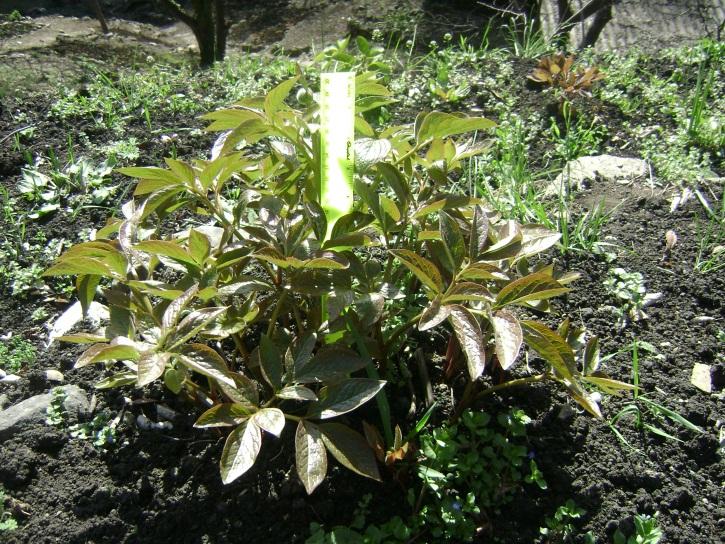
Size and Structure: A large plant reaching up to 150 cm in height. It features a branched, woody rhizome with slight spindle-shaped (fusiform) thickenings. The stem is grooved, angled, and densely foliated.
Foliage: The leaves are green on both sides—almost monochromatic—and glossy on both the upper and lower surfaces. They are generally glabrous (smooth), though sometimes slightly pubescent (hairy) along the veins on the underside. The leaf segments are elliptical, short-pointed, and either long-tapered or rounded at the base.
Flowers: The flowers are large and wide-spreading. The petals are obovate (reverse egg-shaped) and have a yellowish-white hue.
Reproductive Organs: * Anthers: Yellow.
Filaments: Purple-red.
Ovary: Long, oblong-oval or nearly cylindrical, and glabrous.
Stigma: Violet or flesh-red, asymmetrical, and tilted to one side.
Fruit and Seed: The ripened fruit is slightly curved downward. The seeds are rounded with a coarse, net-like (reticulate) wrinkled surface.

Type Locality and Specimen Data
Type: Adjara (Georgia), descent from the head of the Chakvistskali River toward the village of Agara.
Elevation: 800–1000 m above sea level.
Date: July 14, 1893
Collector: N. Albov (Nikolai Albov).
Ecology
It grows from the upper forest belt to the subalpine zone, in the clearings of krummholz (stunted/twisted) forests, on rich, loose soils, and on limestone substrates.
Distribution
Georgia:
Abkhazia: Gagra (Shavrov).
Svaneti: Dadiani Range (Akinfiev).
Samegrelo: Mt. Okhachkue (Kemularia-Natadze, Kutateladze, Mandenova, and Mikeladze); Mt. Jvari (Albov; Khintibidze and Mikeladze); Mt. Migaria (E. and M. Sokhadze; Khintibidze, Mikeladze); Mt. Askhi (Kemularia-Natadze, Khintibidze, Mikeladze).
Racha-Lechkhumi: Mt. Khvamli (Kemularia-Natadze, Khintibidze, Mikeladze, M. Sokhadze); between the village of Khreiti and the Satsalike Range (S. Sokhadze); Nakerala Range near the pass (Bush, Kemularia-Natadze, A. Kutateladze); Nakerala Range near Chishkara (Kemularia-Natadze, G. Chichinadze).
Imereti: Near the village of Partskhnali, in the Tkhmelari district (Buachidze).
Guria: Mt. Simlia (Albov; E. Kikodze); Bakhmaro, Zortiqeli (Albov; E. Kikodze); near the pass, Mt. Gomis (Dolukhanov and Kazarov).
Adjara: Descent from the head of the Chakvistskali River toward the village of Agara (Albov).
Cultivation: It is cultivated in the Tbilisi Botanical Garden (Fomin) and the Bakuriani Botanical Garden (Kozlovsky).
Taxonomic Note
In 1893, N. Albov described a new form of P. wittmanniana from Adjara, while he subordinated the species P. wittmanniana itself to the red-flowered peonies. In 1897, L. Lomakin elevated the form identified by Albov to the rank of an independent species, quite rightly separating it from the red-flowered peonies of the Caucasus.
The majority of subsequent botanists treated the species P. macrophylla as a variety of P. wittmanniana Hartwiss. In the first edition of “The Flora of Georgia” (1942), we shared this view. However, new and abundant material has since convinced us (1961) that P. macrophylla Lomak. is an independent species, distinct from P. wittmanniana Hartwiss.
2. Steven’s Peony (Paeonia steveniana)


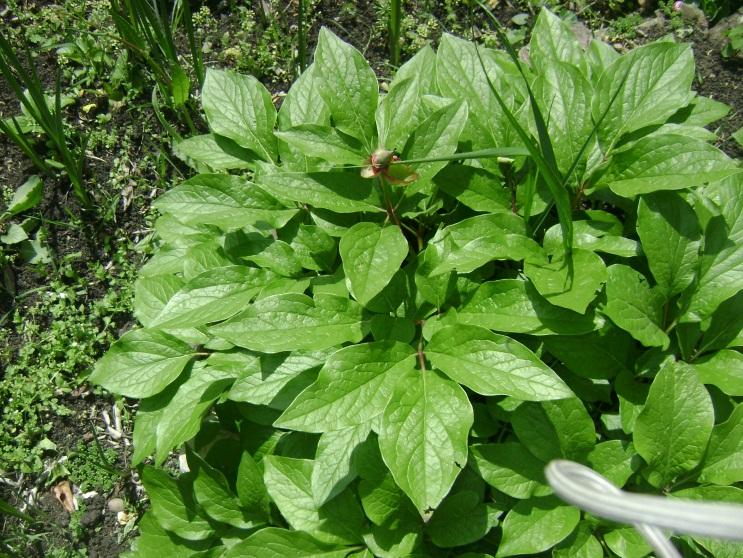
Size and Structure: A large plant exceeding 100 cm in height. The rhizome is branched, characterized by gray, long, narrow, spindle-shaped (fusiform) root appendages. The stem is sturdy and densely foliated.
Foliage: Leaves are biternate (twice-ternately divided); the upper side is green and glabrous (smooth), while the underside is grayish due to dense hairs. The leaf segments are obovate, oblong-oval, or ovate, narrowed at both ends, rounded, or nearly heart-shaped (cordate) at the base.
Flowers: The flower is not widely spread (cup-shaped). The sepals are unequal. The petals are yellow, obovate, and strongly concave.
Reproductive Organs: Both the filaments and the anthers are yellow. The ovary is glabrous and oblong-ovate, gradually transitioning into the style. The stigma is highly asymmetrical, reddish-violet or flesh-red.
Fruit and Seed: The fruit is oblong-ovate, tilted to the side, and glabrous. The seeds are bluish-black.
Type Specimen
Type: Found between Kartli and Akhaltsikhe, in a densely forested valley near Atsquri, 1840, collected by Wittmann (recorded as sub P. Wittmanniana Stev.). The specimen is preserved in Leningrad (St. Petersburg).
Ecology
It grows in the upper forest belt, along forest edges, and in shrublands.
Distribution
Georgia:
Kartli: Borjomi vicinity (Medvedev; Fomin; Sosnowski); Sakochavi (Kozlovsky; Kemularia-Natadze; Barnabishvili; Dumbadze; Chkhaidze); Baniskhevi (Sosnowski, Kozlovsky); near Bakuriani at “Mkheri” (Kozlovsky).
South Ossetia: In a beech forest between Kozaits and Ertso (Kuznetsov); Khodzhekhori, Mt. Sirkh-Leberti, Bubenakheri (E. and N. Bush).
Meskheti: Near Atsquri (Wittmann; Lomakin, Fomin).
3. Wittmann’s Peony (Paeonia wittmanniana)
Size and Structure: The plant stands 80–100 cm tall. The rhizome is branched and develops small, spindle-shaped (fusiform) root thickenings.
Foliage: The leaves are biternate (twice-ternately divided), green on both sides, and either glabrous (smooth) or pubescent (hairy) on the underside. The leaf segments are obovate, pointed or obtuse (blunt), and gradually taper toward the base.
Flowers: The flower is widely spread. The sepals are densely pubescent. The petals are yellowish-white, oval, or nearly rounded at both ends.
Reproductive Organs: The anthers are yellow, while the filaments (stamen stalks) are purple-red. The ovary is oblong-ovate with dense, yellowish, felt-like (tomentose) pubescence. The stigma is purple-red and almost sessile (resting directly on the ovary without a distinct style).
Fruit and Seed: The fruit is tomentose, oblong-ovate, and tilted; the seeds are black.
Type Information
This species was described based on living specimens grown in the garden of the Chiswick Horticultural Society (England). These plants were grown from rhizomes collected in Abkhazia by Wittmann. The type specimen is preserved in London.
Ecology
It grows in the middle mountain belt, along forest edges, in beech forests, and among shrublands.
Distribution
Georgia:
Abkhazia: Tsebelda; Mt. Achkha; Akhupachi; Apiancha (Voronov; Dumbadze).
Bzyb Valley: Along the highway leading from Sukhumi toward Lake Ritsa, approximately 12 km in (Purtskhvanidze; Khintibidze).
Gagra: Vicinity of Gagra (Gusev).
Geographic & Botanical Context
Unlike P. macrophylla (which prefers higher subalpine zones) or P. steveniana (found more in the central/southern regions), Paeonia wittmanniana is strongly associated with the humid, limestone-rich mountains of Western Georgia (Abkhazia).


Note: In 1846 (in the Lindley Botanical Register), a yellow-flowered peony was published under the name P. wittmanniana Hartwiss. In 1848, Steven described a yellow-flowered peony from Meskheti using the same name, based on Wittmann’s material (from a valley located near Atsquri, between Kartli and Akhaltsikhe).
Subsequently, these two species were confused with one another, and recently, all Caucasian peonies with yellow flowers (except for the Lagodekhi species, P. mlokosewitschii) were grouped together under the single name P. wittmanniana.
It is completely obvious that Hartwiss and Steven described two different species—collected by the same person (Wittmann) at different times and from different locations—under the same name. However, because the peony from Abkhazia was described earlier, according to the rule of priority, Hartwiss’s species from Abkhazia retains the original name, while the name of Steven’s species was changed (to P. steveniana).
4. Mlokosevich’s Peony (Paeonia mlokosewitschii)
Size and Structure: A tall plant, 50–100 cm in height, with a woody, branched rhizome and slightly thickened, spindle-shaped (fusiform) roots. The stem is densely foliated.
Foliage: Leaves are biternate (twice-ternately divided), or the upper leaves are ternate (divided into three); rarely, the uppermost leaf is entire (undivided). Both sides, or at least the underside, are glaucous (bluish-gray) or glaucous-green. They are either glabrous (smooth) or covered on the underside with very fine, short hairs. The leaf segments are obovate or oblong-obovate, rounded or shortly pointed at the tip, and narrowed at the base.
Flowers: The flower is widely spread. The petals are concave, oval, with a short and wide claw (base). They are yellowish, often turning greenish at the edges after drying.
Reproductive Organs: Both the anthers and the filaments are yellow. The stigma is pink, sometimes yellowish, sessile (lacking a style), and nearly symmetrical.
Fruit and Seed: The ovary and fruit are covered with dense, yellowish, felt-like (tomentose) hairs. The seeds are rounded, bluish-black, and feature a coarse, net-like (reticulate) wrinkled surface.
Phenology & Cytology: Blooms in April–May (IV–V).
Chromosome count: 2n=10.
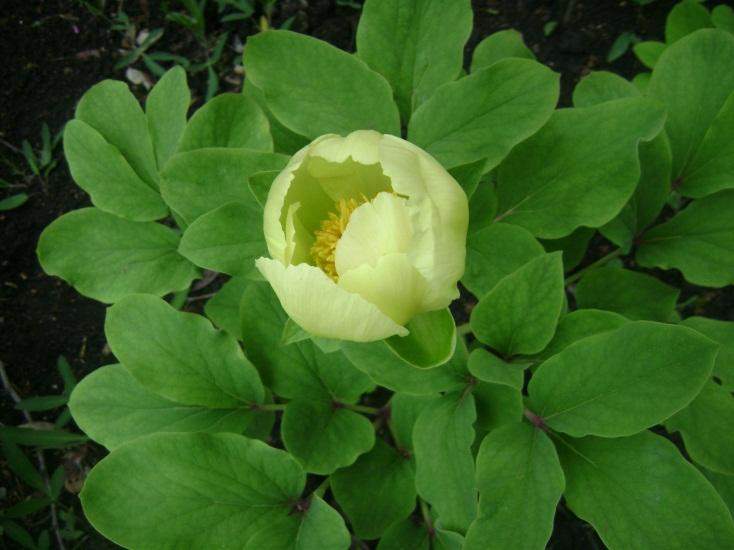


Described from the collection of living Caucasian plants at the Tbilisi Botanical Garden, based on plants grown from material sent by Mlokosevich from Lagodekhi.
Ecology It grows from the middle to the upper mountain belts, in forests, and on stony slopes.
Distribution Georgian SSR: Kakheti: Lagodekhi Gorge, on the slopes of Kudigora (Mlokosevich; Fomin; Koenig; Kappeler; Kemularia-Natadze; Dolukhanov and Kazarova); Kiziki: Shiraki (Schreber; Ketskhoveli). Rest of the USSR: Dagestan, headwaters of the Andiyskoe Koisu (Dolukhanov and Kazarova).
Note: The Talysh yellow peony (P. tomentosa) is often identified with this species, which is completely groundless: the Talysh peony is characterized by coarse leaves with prominent veins, colored grayish on the underside due to long hairs; the leaf segments are ovate or broadly oval, mostly almost heart-shaped or rounded at the base. The flower is widely spread and the petals are only slightly concave; their distribution is also different. Regarding the illustrations included in Grossheim’s Flora of the Caucasus (1950) and Flora of Azerbaijan (1953), they have nothing in common with the Lagodekhi peony, as the images were taken from specimens of the Talysh peony, P. tomentosa.
Section 2. Paeonia – Leaf segments are wide, entire, or sometimes lobed; the flower is red, purple-red, or pink. The fruit is long and covered with felt-like (tomentose) pubescence.
Series 1. Masculae (Stern) Kem.-Nath. – The flower is red or pink. The leaf segments are wide and entire.
5. Ruprecht’s Peony (Paeonia ruprechtiana)
It is a plant 50-100 cm in height, with a branched thick rhizome and narrow spindle-shaped root thickenings; the stem is thick, slightly sinuous, angular, and densely leafy; the leaf is twice-ternately dissected or the uppermost ones are trifoliate, leathery. It is nearly the same color on both sides, green and shiny; leaf segments are broad obovate or almost rhombic, shortly narrowed at the tip and base. The flower is wide open, pinkish-red; petals are broad obovate, wavy-toothed at the tip; anthers are yellow, filaments red; the ovary is oblong-ovate with golden tomentose pubescence; the stigma is red with a broad base and a narrow tip coiled on one side. The fruit is oblong-ovate and recurved, with yellowish tomentose pubescence. Blooms April – May (IV-V).
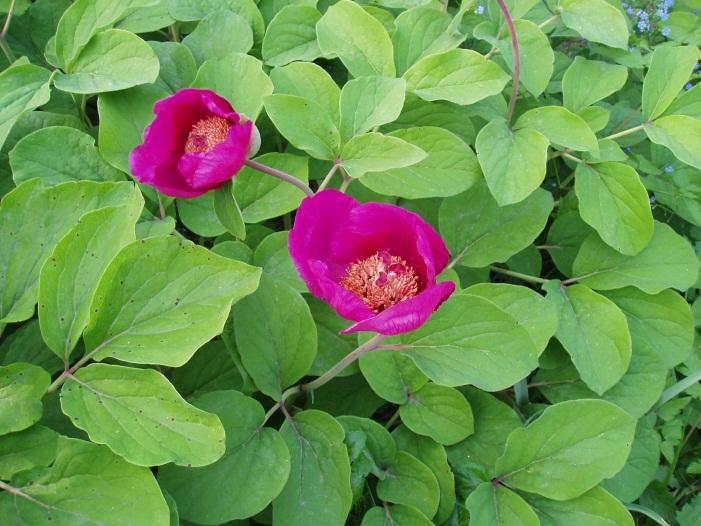


Type: Imereti, Tskhemelari ravine located near the village of Partskhnali
Ecology Grows in the forests and ravines of the middle mountain belt.
Distribution Georgia: Imereti: on the mountain located near the village of Partskhnali, Kharagauli (Buachidze); Kartli: Borjomi (Radde; Kozlovsky); Peter’s Fortress (Radde; Kozlovsky); Baniskhevi, in the Likani Valley (Kozlovsky).
Note: As early as 1869, Ruprecht expressed the opinion that P. triternata f. coriifolia could be distinguished as an independent species. Ruprecht described this form based on specimens collected by G. Radde in Borjomi; subsequently, this plant was collected in 1922-1923 by Kozlovsky in the Baniskhevi and Likani valleys, and earlier in 1916 by I. Buachidze on Tskhmelari Mountain near the village of Partskhnali in the Kharagauli district. The range of this species currently includes the western part of the Borjomi Valley and the adjacent part of Imereti.
6. Caucasian Peony (Paeonia caucasica)
The plant is tall, 50-100 cm in height, with a strongly lignified branched rhizome characterized by spindle-shaped or poorly developed palmate thickenings; the stem is straight or slightly sinuous, densely leafy; the leaf is glabrous on both sides or pubescent underneath; leaf segments are oblong-oval, oblong-ovate, broad oval, or almost rounded, narrowed at the tip or obtuse at the base. The flower is purple-red, usually wide open; petals are obovate; anther sacs are yellow, stamen filaments are purple-red; the ovary is covered in white tomentose pubescence; the stigma is asymmetrical, purple or flesh-red. The fruit has yellowish-gray tomentose pubescence. When ripe, it is almost pendulous; the root is red and black; the mature seed is wrinkled with a coarse reticulate pattern. Bloom time: April – May (IV-V). 2n=10 (diploid).


Type: Unknown; according to “Flora of the USSR,” it is described from Western Transcaucasia.
Ecology Grows in the middle and upper mountain forest belts, in oak-hornbeam forests and forest edges.
Distribution Georgia: Abkhaz.: Near Mt. Chopshira (Albov), Yurevskoe, Tsebelda (Voronin); Svan.: Lentekhi (Sommier and Levier); Racha-Lechkh.: Mindistsikhe between Oni and Khotevi near the village of Nikortsminda (Ruprecht), Mekvena (Brotherus; Sommier and Levier; Kemularia-Nathadze), Nikortsminda and Abanoeti, vicinity of the village Akheti (M. Sokhadze; Kemularia-Nathadze); Samegr.: Between the village Leshamge and Mt. Barkha (Kemularia-Nathadze, M. Dolidze, and I. Mikeladze); Imer.: Qvirila (Lomakin), Sakolia Ridge, Saburo forest, between Gelati and Godoga (Kemularia-Nathadze), Tkibuli dist. near the village Akhal Sofeli on Mt. Tsintskila (A. Kutateladze); Adjara: Between Batumi and Akhaltsikhe, near the village Daizhispāruli (Sommier and Levier; M. Jikidze); Kartli: Borjomi (Radde; Smirnov; Sosnovsky; Kozlovsky; A. Javakhishvili), Tsaghveri, Bakuriani (Shishkin; Sosnovsky; Kozlovsky; A. Javakhishvili), Ateni Valley, between Tana and the pass (E. Kikodze), Saguramo Ridge (Kapiev; Kolakovsky; Gagnidze), Ialno (Shishkin), Tbilisi, near Martqopi (Ruprecht), Tbilisi (Hohenacker), Tskneti (Smirnov); Trial.: Kojori (Zedelmeir; Barabishvili), Tetri Tsqaro (Mlokosevich), Gudarekhi forest (Voronov; Floresky); South Ossetia: Between Kozaito and Ertso (Kuznetsov), Khodze Khori (E. and N. Busch); Outer Kakh.: Kakabeti, Dvria (Z. Qanchaveli); Kakh.: Lagodekhi Valley (Dolukhanov and Kazarova).
Other parts of the USSR: North Caucasus, Kuban (Busch); Azerb.: Lankaran (Stern, as P. mascula Mill.).
Note: For a long time, the Caucasian red peony was identified either with the Crimean peony, named P. triternata or P. daurica, or with the Southern European species P. corallina. Recently, Grossheim (1950) merged it with the Asia Minor species P. kavachensis. N. Busch (1901) quite rightly denied the existence of typical P. corallina in the Caucasus—which is characterized by lanceolate and long-acuminate leaf segments—but he incorrectly subordinated it to the Crimean species. L. Kemularia-Nathadze, as well as V. Komarov and N. Shipchinsky (1937), considers the Caucasian red peony an independent species under the name P. caucasica, with the distinction that she separates two independent species from it: P. ruprechtiana and P. lagodechiana.
7. Lagodekhi Peony (Paeonia lagodechiana)
The plant is 50-100 cm in height; the rhizome is branched, developing spindle-shaped thickenings; the stem is angular and densely leafy; the leaf is twice-ternately dissected, glaucous (bluish-gray) on both sides or on the underside, delicate and smooth, with weakly expressed veins; leaf segments are oblong-elliptical, shortly narrowed at both ends or at the tip. The flower is pink and wide open; petals are obovate and slightly concave; anther sacs are gray; stamen filaments are purple; the ovary is covered in yellowish tomentose pubescence; the stigma is red and nearly symmetrical.


Type: Lagodekhi Nature Reserve, Ninigora, in the forest 10.V.1953. A. Kazarova and A. Dolukhanov. Preserved in Tbilisi.
Ecology Grows in the forests of the middle mountain belt.
Distribution Georgia: Kakh.: Lagodekhi Nature Reserve (Kemularia-Nathadze; Dolukhanov, Kazarova). Rest of the USSR: Dagestan.
Note: With its delicate, glaucous leaves, this species closely resembles P. mlokosewitschii, from which it is well distinguished by its pink and larger-sized, wide-open flower, the color of the stigma, anthers, and stamen filaments, as well as the shape of the leaf segments.
Section: 3 Sternia Kem.-Nath. — Leaf segments are toothed or multiple-times dissected into lanceolate or linear segments. The flower is purple-red, red, or pinkish-violet. The fruit is tomentose-pubescent, short-ovate or oval.
Series 1. Hybridae Kem.-Nath. — The leaf is twice or thrice pinnate or divided into narrow-linear segments.
8. Majko’s Peony (Paeonia majko)
The rhizome is branched, almost horizontal, and characterized by spindle-shaped thickenings; the stem is tall, densely leafy, and retains its lower leaves for a long time; the leaf is green and thrice deeply pinnately dissected or divided into narrow-lanceolate segments 5-10 mm in width; the lower leaves are broader than the upper ones. The flower is large, pinkish-reddish-violet, and wide open; the ovary and fruit are covered in tomentose pubescence consisting of white or, more rarely, red hairs. The fruit is short and oval.
Type: Kartli, between the villages of Lamisqana and Igoeti, 16.V.1958. N. Ketskhoveli. Preserved in Tbilisi.
Ecology Grows on foothills, at the edges of oak-hornbeam forests.
Distribution Georgia: Kartli: near the village of Igoeti (N. Ketskhoveli, T. Dumbadze; T. Menteshashvili).


Note: This species resembles P. hybrida Pall., which is distributed in wild meadows, open grasslands, or stony slopes of hills in Siberia, Altai, and Central Asia; it was described from the vicinity of Barnaul. It also resembles the Crimean peony, which V. Maleev cited in 1937 under the name of the hybrid peony P. tenuifolia x P. triternata.
Series 2. Fissae Kom. — Leaves are multiple-times dissected into narrow-linear or almost filiform segments. The fruit is tomentose-pubescent, ovate or oblong. Root thickenings are rounded or spindle-shaped.
9. Kartli Peony (Paeonia carthalinica)
It is a plant 20-50 (80 cm) in height, with a branched, strongly lignified rhizome and spindle-shaped long-stalked thickenings on it; the stem is strongly grooved, densely leafy, with no leaves at the base of the stem; the leaf is green, glabrous; leaf segments are linear-lanceolate, 5-10 mm wide, spreading.
The flower is wide open; sepals are broad-oval; the outer sepals are similar to the linear segments of the leaf. The petals are obovate, cuneate-narrowed at the base, rounded at the tip, and dark purple in color; stamen filaments are entirely purple or yellowish in the upper part; anther sacs are yellow; the ovary is ovate, covered in golden-colored tomentose pubescence, and reddish. The seed is large, oval, initially with fine-pointed wrinkles, but when mature, it is shiny and smooth.


Type: Kartli, near the village of Mukhrani, 1921. Ketskhoveli. Preserved in Tbilisi.
Ecology Grows in the foothills, on wasteland, and within thorny shrub and Veri (steppe-like) formations.
Distribution Georgia: Kartli: Gori district, on the Dampalo hills near the village of Mukhrani, in shrubbery (Ketskhoveli; Kemularia-Nathadze), Tirzdnisi (Ketskhoveli); Kiz.: Shiraki (Kakulia, Sokhadze, Kebadze), between Kedi and Shavtava (Z. Qanchaveli).
Note: The Kartli peony, with its multiple-times dissected leaves and dark purple flowers, is closely related to P. tenuifolia, which is described from the Ukrainian steppes, and also to P. biebersteiniana Rupr., known from the Stavropol massif. However, it differs from the former by the shape of the petals and long, thin leaf segments; and from the latter by its glabrous (hairless) leaves, thin segments, and its distribution range.
10. Fine-leaved Peony (Paeonia tenuifolia)
The rhizome is oblong and tuberous, with short-stalked thickenings; the stem is simple, 10-50 cm in height, and densely leafy; the leaves have very narrow, almost filiform (thread-like) segments, 1-2 mm in width.
The flowers are large, 3-5 cm in diameter; the petals are dark red, obovate in shape, and rounded at the tip and base. The anthers are yellow, and the stamen filaments are reddish. The ovary and immature fruit are thickly covered with red tomentose hairs. The fruit is short-ovate or oval in shape, slightly tilted to the side, with brownish-red pubescence. The seeds are black-brown and shiny.


Ecology Grows in steppes and shrublands.
Distribution Georgia: Kartli: village of Samtavisi (Volchanetsky), village of Tsilkani (Dumbadze), Igoeti (Ketskhoveli), Tirzdnisi (Ketskhoveli); Kiz.: Shiraki, Lekistsqali (Kakhelidze, Gavrilenko; Sokhadze, Kakulia). Rest of the USSR: Ciscaucasia; Transcaucasia (Azerbaijan); European part. General distribution: Central Europe.
Economic Importance All species of the genus Paeonia are highly decorative and find great use in floriculture. While Chinese and Japanese peonies attract particular attention, our native peonies are no less beautiful (with the exception of the Chinese tree peony). Some have already been introduced into cultivation: P. mlokosewitschii Lomak. since 1897 in Switzerland, and P. wittmanniana Hartwiss since 1846 in England, from where it spread to other European countries. The first pioneers of introducing peonies into cultivation in our region were the workers of the villages near Tbilisi, who brought the Kartli peony to the city in large quantities for this purpose.
Among scientific institutions, Tamar Dumbadze worked at the Tbilisi Botanical Garden on the study of peony biology and their introduction into cultivation. Currently, employees of the Department of Rare and Endangered Species continue this work. A decorative hybrid peony—P. tenuifolia x P. caucasica Maiw.—developed by the late G. Matveev, has been flourishing for more than 10 years in the Living Flora Department of the Institute of Botany of the Georgian Academy of Sciences.
Conclusion
Of the 12 species known from the Caucasus, 10 species of peony are distributed in Georgia. Among these, the Caucasian (Paeonia caucasica) and Ruprecht’s (Paeonia ruprechtiana) peonies are characterized by the widest distribution. Species with a narrower range include the Lagodekhi (Paeonia lagodechiana) and Mlokosevich’s (Paeonia mlokosewitschii) peonies, although they are also distributed across the forested and stony ecotopes of neighboring Dagestan. Additionally, Maiko’s (Paeonia majko) and the Kartli (Paeonia carthalinica) peonies grow in the oak-hornbeam foothills of the village of Lamisqana in eastern Georgia, specifically the Kaspi district. The range of the fine-leaved peony (Paeonia tenuifolia) is also restricted to eastern Georgia (Gori district: Samtavisi, Tirzdnisi, Igoeti; Dedoplistsqaro district: Shiraki, Lekistsqali).
The ranges of the large-leaved (Paeonia macrophylla) and Steven’s (Paeonia steveniana) peonies mainly cover western Georgia (Abkhazia, Adjara, Racha). The range of Steven’s peony also extends between Kartli and Akhaltsikhe (the Atsquri forest ecosystem) and along the edges of beech forests in the subalpine belt of Bakuriani.
Observations of the phenorythmics of peony species confirmed that Mlokosevich’s peony (Paeonia mlokosewitschii) emerged earliest and, accordingly, began flowering first. Maiko’s peony and the large-leaved peony emerged and began flowering the latest. The Caucasian peony (Paeonia caucasica), Ruprecht’s peony (Paeonia ruprechtii), and Mlokosevich’s peony were characterized by higher fruit productivity (number of capsules).
In the future, it will be interesting to compare the vegetation periods of natural peony populations with those of species present in botanical gardens. Comparing these data over 2, 3, 5, or more years will provide insight into the impacts of global warming, both in the vicinity of Tbilisi and across the diverse biomes and vertical belts of different regions.
References
Key to the Plants of Georgia, Vol. II, Tbilisi, 1964.
Flora of Georgia, 2nd edition, Vol. II, Tbilisi, 1973.
Sh. Shetekauri & M. Jacoby, Flowers & Trees of Caucasia, Istanbul, 2009.
Hong De-Yuan, Peonies of the World: Taxonomy and Phytogeography, Royal Botanic Gardens Kew, UK, 2010.