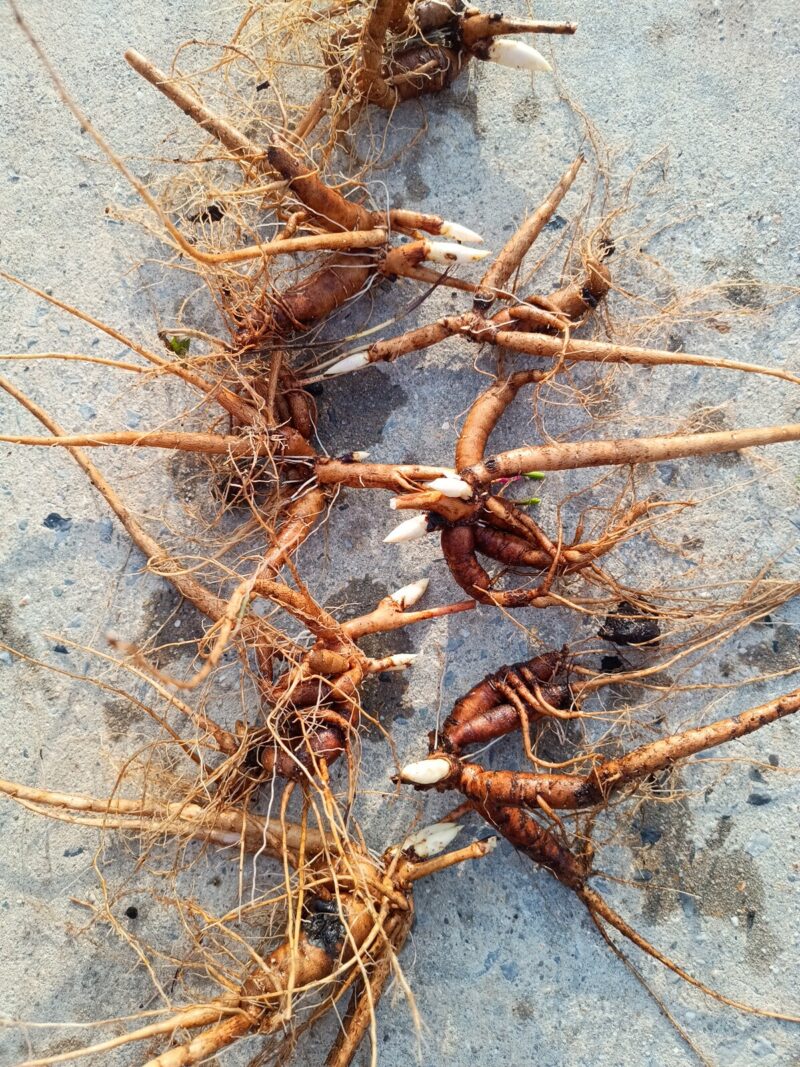
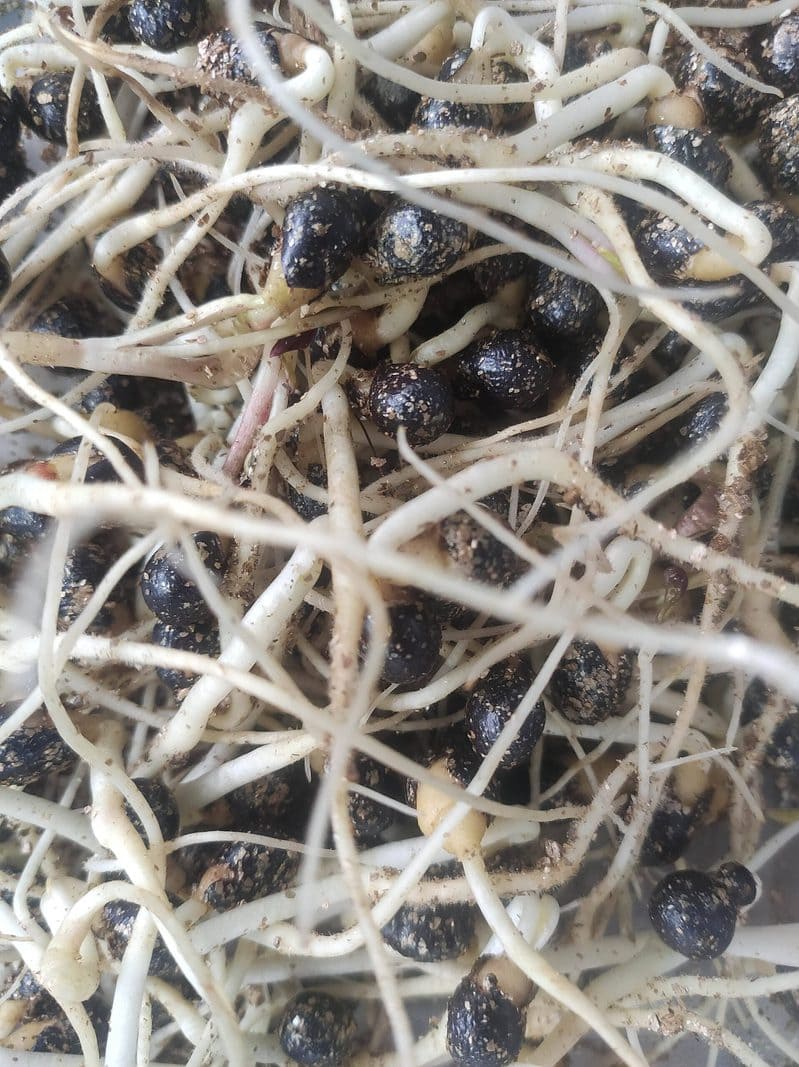
A few years ago, end of 2022, we did a small experiment to find the best substrate to germinate peony seeds. You can read all about it here. Now for most years this has worked quite well for us, but last Fall we did notice that there were quite a large number of ziplock bags with a (very) high proportion of seeds that had sent out a root, but where this root then subsequently completely rotted or where the tip of the root had rotted . Most of the times this could be seen with what we consider the most interesting seeds, which led to some slight swearing. Some other bags had no problems at all. Clearly, time to have another look at our previous experiment and see where it went wrong or where it could be improved upon.
-

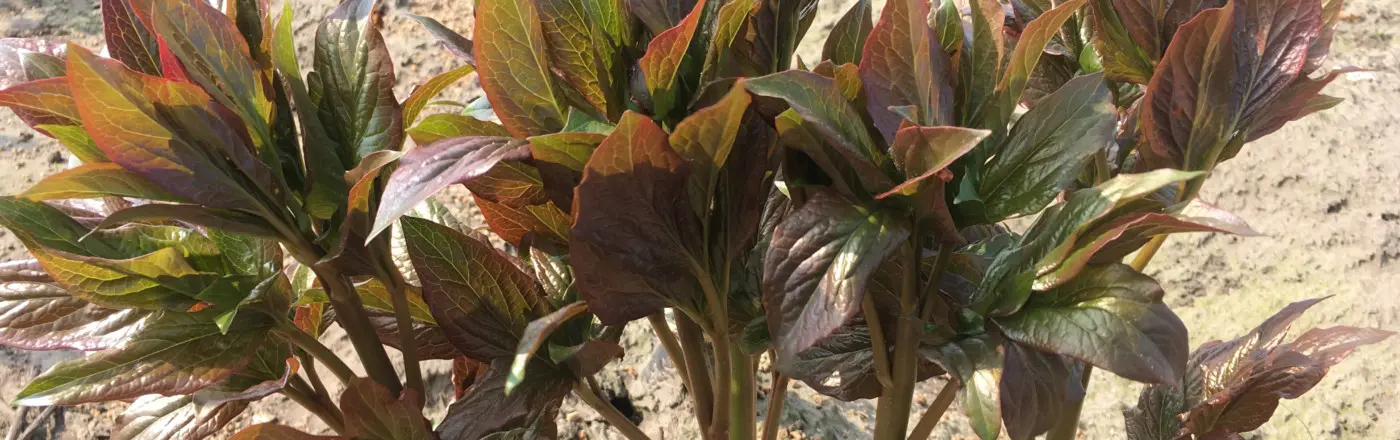
- Good roots

-

- Rotted root tips

This is the original table from 2022:
| % water | Long roots | Average roots | Short roots | No roots, good seeds | Rotted seeds |
| Coarse river sand | |||||
| 10% | 20 | ||||
| 25% | 20 | ||||
| Perlite | |||||
| 0% | 20 | ||||
| 5% | 2 | 1 | 2 | 15 | |
| 10% | 3 | 1 | 16 | ||
| 15% | 5 | 1 | 14 | ||
| 20% | 1 | 6 | 4 | 9 | |
| 25% | 8 | 12 | |||
| Vermiculite | |||||
| 0% | 20 | ||||
| 5% | 9 | 1 | 8 | 2 | |
| 10% | 9 | 2 | 3 | 2 | 4 |
| 15% | 5 | 2 | 3 | 10 | |
| 20% | 7 | 1 | 2 | 10 | |
| 25% | 6 | 1 | 1 | 12 | |
| 30% | 7 | 6 | 1 | 6 | |
| 35% | 1 | 1 | 2 | 8 | 8 |
| 40% | 3 | 6 | 11 | ||
| 50% | 20 | ||||
| Total always 20 seeds per treatment. Numbers with orange background had some rot at the end of the roots. Green background shows the best treatment. Seeds harvested August 11th. Treatments started August 12th. Opening of ziplock bags November 10th. | |||||
Back then we concluded fresh dry vermiculite with 10% water was the best germinating substrate. It had the highest number of germinated seeds, 14 out of 20 seeds. Higher concentrations of water in the vermiculite led to more rotted seeds up until the turning point where too much water actually completely prevented any development.
The clue to the problem lies with the lower concentrations: 5-10-15%. It is not because 10% gave us the highest germination percentage, that it is actually the best treatment. After all, we went in steps of 5%, it might well be that a concentration somewhere around 10% is somehow better. It seems reasonable that this would be between 5 and 10%, and not between 10 and 15%. After all, at 15% half of the seeds had rotted. At 5% there was less germination but it may be that the 8 remaining seeds were only slower in this treatment and would eventually have sent out a root. I can no longer check that nor do I have data for that, the seeds were thrown away after the experiment.
Having looked at my ziplock bags this year. The rather usual crosses between ‘advanced herbaceous hybrids’ did quite well, with hardly any losses to rot. The experiment was with open pollinated seeds of Just Peachy, I suppose these also fall into that ‘easy’ category. The problems were with my seeds from more difficult crosses: seeds from species; seeds from hybrids x species and reverse; seeds from crosses with more ‘difficult to grow’ hybrids. Many of those are known to have much more difficulties growing in wet circumstances.
And so we changed course. Instead of opting for a 10% concentration of water in the vermiculite, we have decreased this to some 7% instead, which is in between the two best treatments. We have recently received some seeds that can be allocated to the more difficult group, see the image below.
-

- Seed packages. All from open pollination, the mother plants are indicated each time.

Seed packages. All from open pollination, the mother plants are indicated each time.
Now, these seeds then received the following treatment:
- 72 hours of soaking in water with 200 ppm GA3 and some biostimulants
- placing them in ziplock bags with vermiculite wetted with 7% water
- shaking them very well so that the still attached water to the seeds from the previous soaking did not wet the vermiculate attached to it even more (drying the seeds first with a towel might also have worked obviously)
- placing them in a ‘wine cooler’ that could keep them at 18-20°C for several months
Now the temperature treatment was only started Dec 11th and we’re now Jan 28th. That’s a bit too short to say it was completely successful, but several seeds have already sent out a root (some species are faster) and from what we see now, it seems the ‘rot’ problem is largely gone. We had also added some dry vermiculite to older ziplock bags to decrease the concentration of water in it and here as well we do see better results already.
If all goes well, in a month’s time we can add more definite results, but given what we see now, we are already quite sure to say that it is probably better to only use a 7% water concentration instead of the aforementioned recommendation of 10%. For many ‘easy’ crosses, the difference will only be marginal, but not all crosses are such.
-

- P. macrophylla x open. 3 days of soaking with 200ppm GA3 and biostimulants. 7% water in fine grade vermiculite, well shaken before temperature treatment started Dec 11th.