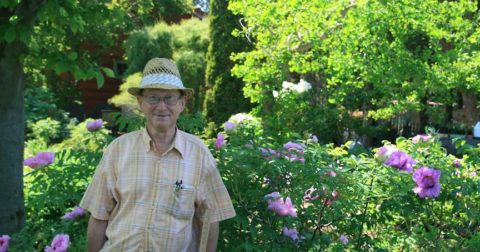
Bill Seidl, a well-known American hybridizer of advanced herbaceous and tree hybrid peonies, passed away October 8th, 2016. I’ve...
P. officinalis Rubra Plena. Species: P. officinalis. History: Origin very ancient, doubtful. DESCRIPTION IN BRIEF: Bomb, amarante red, very early, good. DESCRIPTION IN DETAIL: Bomb type, the typical old double red of our grandmothers’ gardens. They usually have carpels which are woolly, but well concealed, foliaceous bracts directly under the flower, no stamens or anthers. Color amarante red 4(168), even throughout. Size medium to large. Odor neutral to unpleasant. Foliage glabrous above, pilose beneath, margins entire and green — typical officinalis foliage.
Carsten Burkhardt: "The precise classification of herbaceous peonies in this group is problematic, as many cultivars identified as Paeonia officinalis in the 20th century are actually descendants of Paeonia peregrina. Until the 1930s, all peregrina types were also referred to as Paeonia officinalis. I doubt that a large part of this group has anything to do with Paeonia officinalis at all—starting with the well-known common garden peony 'Officinalis Rubra Plena,' which is either a cultivar of Paeonia peregrina or (more likely) a hybrid of Paeonia peregrina and another wild species, perhaps Paeonia officinalis."
No seedling number, labeled "RPWS-19" by Seidl. Itoh hybrid. Parentage Lactiflora x shrub hybrid, possibly 'Thunderbolt.' First year bloomed (guess) 1974-1976. Rec'd from Roy in 1979. Small 3-4" single black red, 10 petaled terminal flowers, bloom just on top of foliage, followed by a few late stems w/o laterals that bloom still higher. Vigorous plant, 30" height, dense green segmented leaves—young foliage deep red, remaining for some time. Somewhat narrowed petals. No seed, and extremely sparse pollen. An excellent landscape plant for foliage. Seedling # RPWS-19
(Silvia Saunders), 1971. Dainty noddling red windflowers swaying gracefully on thirty-six inch stems. This rare Early Windflower F-2 plant is a delightful garden addition. It should be of interest to the hybridizer.
Parentage (SH-35: Golden Era x Chinese Dragon) x Zephyrus. Hybrid tree peony, first bloomed 1992. Light pink shading darker to rose burgundy flares, filaments, sheath and carpel tips. Similar to Shintenchi but a shade lighter. 6" flowers are single, the 1
[vc_row][vc_column][vc_column_text]
Seedling 79H18-2. Parentage: Seedling 71Y6-1 x Seedling 74119-5. The seed-parent was a yellow single, yellow being the object of the cross. The pollen parent was a pink double. Has had prior distribution under the garden name “Bill’s Best Yellow.” First bloomed 1982. Light yellow DOUBLE. Flowers are round and double on established plants, semi-double on new plantings. Rounded petals have an irregular toothed edge. Green carpels (4-5) with red stigmas which are not visible on double flowers, but can be seen on semi-double blooms. Pollen bearing stamens are light yellow. Fertile both ways. Fragrance. Foliage is wide and deep green. Each stem produces 1 strong primary bud, but may have up to 3 more secondary buds, making a long bloom season. Stems are tall (36 inches (90 cm)) and strong. No staking is needed. Rapid growth rate.
[/vc_column_text][vc_gallery type="grid" images="21612,21611,17478,17477,17481,17482,18363,21610,18364,17484,17480" img_size="medium" grid_number="3" gap="large"][/vc_column][/vc_row]
Parentage, Blushing Princess x Sparkling Windflower. First bloomed about 1985. Pink hybrid, good substance, reliable, one bud per stem, seeds. This pink double flower has petals tending to be of uniform size, giving the flower a carnation-like appearance.
Seedling 16350 F2. Hybrid, blush pink, semi-double. It has stamens, pollen and seeds. Most reliable. Excellent substance, 32" in height. Fragrant, early to midseason bloom. Large medium green foliage. Sometimes the flower has so many petaloids in the center that it is close to double. This seedling came via the Reath Nursery. It was named by David Reath and registerd by Caprice Farm Nursery, August 15, 1991.
Double type; very large; early. White, with prominent crimson flakes on a few central petals; fairly fragrant. Tall; very floriferous; stems usually strong. Foliage large, dark green. Excellent for both garden decoration and cutting. The flowers are globular, with wide petals of heavy substance, loosely arranged, and last well when cut. An old, thoroughly tested variety whose merit is proved by its very great popularity. "Does not last well when cut. Chicago market says it is a poor cut-flower."— Brand. "Splashed, streaked, and edged with crimson. Usually flatfish rather than globular."—Saunders. "Stems good but not rigid by any means—rather spreading."—Little.
5', several flowers to a stem, late, single, white. Centers differ from other single peonies. Stamens look like pistils, later they get pretty red tops. Side buds have two pistils. Flowers not too numerous. Late. Very few seeds. Long flowering.
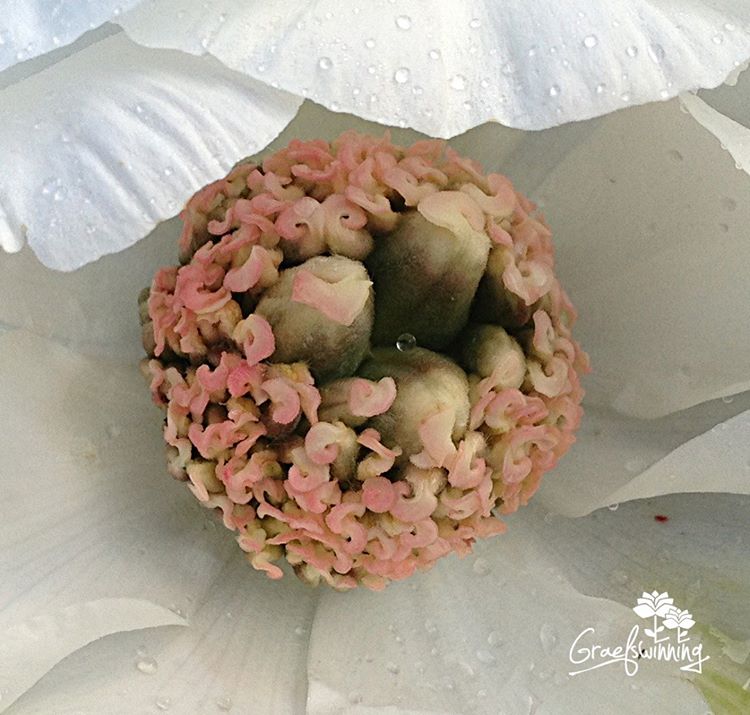
Graefswinning:
Continuing our mini-tour of Prof. Saunders crossings. We all like something early in bloom, but to extend the flowering season he also experimented - very successfully - with late flowering varieties. White Innocense is an emodi x lactiflora cross. The flowers on tall slender stems have a striking greenish center accentuating even more its friendly-ghostly 👻👻👻appearance. Quirky seedpods extend the period of interest even further into the summer. These may remain on the plant on condition it is healthy and very well established. With its 150cm height it is an eye-catcher for your garden as a specimen plant or in a flowerbed in combination with other cool colours. 🌸
Itoh hybrid-sometimes double-sometimes single. Parentage Lactiflora seedling (L2), a white-cream anemone x Alice Harding. First bloomed 1976. Medium yellow with light red flares, very single to very double (single most years), 20" height, 2!/2-3 ft. wide.
Chinese Dragon (Saunder, 1948). Lutea hybrid.
Single; 10-14 petals, purple-crimson. Flares large and dark. Filaments coarse, maroon. Stigmas almost crimson; sheath purple. Foliage luxuriant, finely cut, with bronze tips. Stems purplish-crimson. This variety should perhaps be classed in Group 5.
Note: Awarded the American Peony Society’s Gold Medal in 1983.
Parentage Anna Marie x Shintenchi. Hybrid tree peony, first bloomed 1993. Ruffled petals are fuchsia or vivid reddish purple, as is the sheath, darkening to burgundy flares and filaments; carpel tips are deep pink. Sparce vestigal stamens are naked, i.e.
Double hybrid; parentage Salmon Dream x Reath No. F-3: Cream Delight x Moonrise; first bloomed 1980. Lemon Yellow, hybrid, double ball; stamens, pollen, and seeds; heavy substance, floriferous; strong stems, bloom held erect; 32 inches; midseason hybrids, June 11; attractive deep green foliage. A very fertile seedling with bloom of bomb to ball-type double. Seedling Reath 80-4.
Parentage Rock's Variety x Kamata Fuji. First bloomed 1990. This Moutan tree peony is Double lavender with stamens, pollen and seeds. Reliable, good stem strength, height 36" high x 54" wide. Early bloom. Lavender petals and filaments, cream lavender she
Usually growing in steppes, meadows, open sandy dunes, shrubs, or at the edges of forests. Paeonia tenuifolia seems to prefer dry habitats, and was found growing at lowlands below an altitude of 900 m. Armenia, Azerbaijan, Bulgaria, Georgia, Romania, Russia (the Caucasus), Serbia, Turkey (European part) and Ukraine.
Paeonia tenuifolia as circumscripted here is a very distinct species. It has the finest leaflets/leaf segments and the greatest number of leaflets/leaf segments of any peony species.
More info
Growing in bushes and grasslands, but also in open woods, at altitudes from lowlands to 2,300 m, but to 3,400 m in Sichuan Province (Kangding), China. In E Asia: China, the Korea Peninsula, E Mongolia, and Russia (the Far East and SE Siberia).
The most distinct character of Paeonia lactiflora is the cartilaginous thickening along the leaf margins, which are dentate—spinose on these thickenings.
More info
Parentage Minnie Shaylor x Red single seedling. First bloomed 1981. Bi-color red and white double lactiflora. Long, fair amount of stem strength. Flower might need support, 30-36 inches in height. Stamens, pollen and seeds. Mild fragrance, mid-to-late blo
Anna Marie x Shintenchi. Hybrid tree peony; double white. Detailed information will appear in a later Bulletin. Seedling # 171.
Single Itoh hybrid. Parentage (probable) Lactiflora seedling, L5, single purplish-red seedling of Harriet Olney x Chinese Dragon. Bloomed about 1976. Dusty rose, single with darker flares, silvery picotee, especially as flower ages; 5-6 gray-green carpels
[vc_row][vc_column][vc_column_text]
Double herbaceous hybrid. Salmon Dream x Lemon Chiffon. First year bloomed 1987. Ploidy-Tetraploid. Pastel creamy-pink double with stamens interspersed throughout and clustered around carpels which are not hidden. Tetraploid. Fertile both ways. 30" height holds flower erect. Large but not coarse semi-glossy foliage, midseason bloom. Seedling # 82SDLC-4.
[/vc_column_text][/vc_column][/vc_row][vc_row][vc_column][vc_gallery type="grid" images="21666,21667,21665,21664" img_size="medium" grid_number="3" gap="large"][/vc_column][/vc_row]
[vc_row][vc_column][vc_column_text]
Parentage, Paula Fay X Moonrise; Sib. of F-11; First bloomed in 1974. Hybrid, pale salmon pink, semi-double, flat flower. Reliable, good substance, pollen and seeds. Sturdy stems, 30 inches in height, early bloom with other lobata hybrids, deep green glossy foliage. Seedling of Paula Fay, similar plant habits. The pale salmon pink color shows the cream inherited from Moonrise. Sets seeds very easily. Does not form adventitious buds on root cuttings, therefore slower of propagation. Proven useful for hybridizing. Seedling # F-10
Award of Landscape Merit (ALM) description: 'Salmon Dream' (Reath, D.L., 1979) Herbaceous Hybrid, Early, 30" — A light, salmon pink, semi-double with rounded, gently cupped petals that are creamier at their edges and flatten as the bloom develops. Petals possess good substance and a satin sheen. A center boss of yellow stamens surround light green carpels tipped with light pink stigmata. Younger plants are more apt to produce self-colored petaloides that emerge through its center, giving the bloom a fuller appearance. Stems are strong and erect, standing well during the bloom cycle and creating a tidy compact plant. Flowers nestle just above shiny, medium-dark green foliage that covers to the ground, a beautiful presentation of a bush in bloom. Post bloom bush is attractive. Juvenile stems and leaflets emerge chartreuse green tinged red. Moderate increase in situ. Propagates by division and has proven to be moderately adventitious. 2008 Gold Medal Winner and 2009 Peony of the Year
[/vc_column_text][/vc_column][/vc_row][vc_row][vc_column][/vc_column][/vc_row]
Semi-double white Jap. tree peony. Pollen parent. Shintenchi. Seed parent. Rocks Variety. First bloomed 1989. First divided— grafted. Height 32-36". Large white blooms, semi-double with purple flares. Strong large plant with good form. Looks much like a d
Seedling # None. Garden name has always been "Jr. Miss." Double lactiflora. Parentage Laura Dessert x unknown. First bloomed (guess) about 1972, received from Roy in 1978. Medium pink, lighter in dry weather. Very tight full double bud. This full double f
D. E. Red. Seedling No. not given. Parentage not given, Fourth generation hybrid. Double red with heavy substance, large plant and roots. Excellent keeper, late blooming for a hybrid.
Award of Landscape Merit (ALM) description: 'Old Faithful' (Glasscock / Falk, 1964) Herbaceous Hybrid, Late mid-season — Big, velvety, deep red semi-double/double blooms are held aloft stout, medium tall stems. Makes a robust and dramatic presentation when in bloom. Color is clear. Petals are many and possess excellent substance and holding power. It’s a late bloomer for a hybrid. Buds show color long before opening. May prove to produce less stems in more southern climes. It’s difficult to divide and slow to increase, factors that contribute to its pricey and limited availability. 1997 Gold Medalist
Single lutea hybrid tree peony. Parentage, Reaths A197 x Daphnis numbered seedling, light yellow. First bloomed 1983 (six blossoms). Lavender, darker flares, selected for its smooth orchid-lavender coloring a break-through derived from two light yellow parents. Darker burgundy flares; anthers are light yellow without pollen, light filaments shade to purple base; carpels and stigma are green, 10-12 petals. Foliage and fragrance are typical lutea hybrid. About 30 inches tall in this climate. Terminal buds bloom, one per stem. Dieback has occured at -15° F without protection, followed by sparse bloom and strong basal growth. Has set some viable seeds by Chinese Dragon and CD seedling. Named in memory of my mother. Seedling # A1-13.
Lutea hybrid Parentage—Golden Isle x Daphnis fertile pollens First bloomed 1971 Yellow, reddish flares, stamens, pollen, seeds, fragrant. One to three buds per stem, moderate amount of bloom, sturdy stems, flowers held high above the foliage, 5' height. Bloom in lutea hybrid season, sturdy growth, heavy textured leaves. Carpels green, cream stigmatic tips, reddish maroon flares at base of petals, radiates outward. Very light reddish picotee edge on most petals, very heavy petal substance. Fertile pod and pollen. Seedling # A199
(Oriental Gold x Claire de Lune. Light yellow double hybrid. Ball form, one to three buds per stem. No pollen, does have seeds, no fragrance, no stamens. Average amount of bloom. First bloomed 1970. Height 28". Very adequate stem strength to hold the flower. This plant does not show any evidence of the variety Claire de Lune. It appears quite similar to Oriental Gold above ground but the root system almost typical Lactiflora and unlike either of its parents. Earlier bloom than Oriental Gold. Light green foliage. Does not have yellow-green sprouts when emerging as does Oriental Gold. Seedling # 6502.
White, faintly flushed, fine substance. Foliage silver gray touched with crimson edges.
herbaceous hybrid, double. Parentage: Salmon Dream, lemon chiffon. First year bloomed 1987 Ploidy-tetraploid. Medium rose pink, wide guard petals frame a mound of smaller petals. Ball form or in between. Tetraploid. Fertile pollen. Stamens clustered aroun
28". Single, pale pink to near white, big flowers are 5 inches across, paler near petal bases, large center pink in effect. Wide plant, leaves big and narrow, decrease toward flowers.
29". Single, big flat flowers, ivory with pink flares. Small yellow stamen clusters, red pistil tops.
Seedling number, Garden names: Roy's D.W., "RP-SSD," "Green Viking." Double herbaceous hybrid. Parentage, Sanctus x a non white F3 derived from Silver Dawn. First year bloomed (guess) about 1974-75. Rec'd from Roy 1978. White double form, large inner petals, ruffled, cupped and crimped; outer petals large, broad, shaded green underneath. Stamens clustered around small carpels tipped red. Tetraploid. Fertile pollen when used on other tets. Medium large foliage, husky upright stems, usually no laterals. 30-36" height, midseason bloom. Seedling # RP-SSD
[vc_row][vc_column][vc_column_text]
Parentage - unknown - chance seedling - might be of Mons Jules Elie. First bloom 1974 - a full double, all subsequent years blooms single. Single light pink lactiflora - early to midseason bloom, no fragrance. 32 inches in height, many stems, stiff and wirey. A very nice plant but not valued for its beauty of flower but rather for the hybridizer. A proven seed parent for the Itoh hybrids. Highly fertile both ways with large seeds in great abundance. An apparent break-through for the hybridizer. Seedling # S 172
[/vc_column_text][vc_gallery type="grid" images="21644,21645,21646,21650,21648,21647,21649" img_size="medium" grid_number="3" gap="large"][/vc_column][/vc_row]
First bloomed 1968. Parentage. Generation—BC-1; Thunderbolt x F2 (A). Deep brick red. The purest of all reds, Double. Petals ruffled and pointed. One feels the warmth and fire within each flower. Good stem strength, has pollen, seeds and fragrant. Reliable. (God of Fire). Seedling # D-240
Itoh full double yellow hybrid with red flares. Seedling #A81-10. First bloomed 1986. Parentage, white lactiflora double x Reath hybrid tree. This Itoh is a large full double yellow ball with red flares, 6-8" blooms with strong 32" stems holding the flowers on top of the plant. Above average bloom. 30 blooms the first year of blooming size. Excellent substance. No seed or pollen. Fragrant. Color of pollen parent A 198. Seedling # A81-10.
Award of Landscape Merit (ALM) description: 'Bartzella' (Anderson, R.F., 1986) Itoh Group, Late mid-season, 32? — Large (six–eight inches) semi-double to nearly double, fluffy, medium lemon yellow blooms with soft red flares radiating from its center. Petals possess good substance. Blooms emerge through the foliage over the entire surface of the bush, coming out from the sides as well as from the top. Possesses an ultra-vigorous growth habit and is a prolific bloomer with one report of an exceptional 22 blooms on a second year plant. Stems are strong and will produce an occasional side bud, extending the blooming season. Bushes are densely foliated with medium sized, finely cut, somewhat upward pointing leaflets. Excellent landscaper for the front of a mixed border of taller perennials. Increases very quickly, may be divided after its third year. Older plants may end up yielding multi-eyed divisions, larger in size, yet not much larger in number. 2006 Gold Medalist
29". Single, early, pale ivory yellow, flowers.
35". Single. Clear pink, big flowers, a bit crinkled and mottled, 6 inches wide. Average number of flowers, big heavy long bright golden stamens. Near white pistils have red tops. Fairly dense plant, big leaves, flowers carried high above bush.
Award of Landscape Merit (ALM) description: 'Roselette' (Saunders, 1950) Herbaceous Hybrid, Very early, 36?, Strong scent — Second generation hybrid descended from P. lactiflora, P. mlokosewitschi and P. tenuifolia; single. For those chomping at the bit each spring, 'Roselette' is prized for its early blooms that usher in the season of full size peonies. Each warm pink bloom is cupped and crinkled, consisting of nine or ten petals with occasional hairline streaks of cool red running their length along vein lines. A feather flare of light pink is evident on the backside of the petals. Stamen filaments are lighter and more lemon in color than the stamens. Carpels are light lemon green and tipped deep red. Erect stems hold blooms high above the bush. Mature blooms remain attractive withstanding early spring winds. Light green foliage is dense and, if Roselette is well situated and watered, durable all season, a legacy of its big-leafed peony heritage, P. macrophylla. A model of health above ground, so too 'Roselette' is below, with unearthed six-year old plants showing no evidence of root rot. Establishes and increases stem count quickly. Propagates readily by division, yielding superior “wagon wheel” type bare roots, attached to three–five eyed crown. Also propagates by adventitious roots. Suitable for landscape only.
a leaf is 'segmented' when it consists of pieces of various shapes, which are more or less separated from one another
Also known as "Laning's Best Yellow." Parentage, Quad F3 x Moonrise. First bloomed 1975. Full double of medium yellow color with purple red flares at the petal base. Foliage deep green, 30" height, standing fairly erect. Sets seeds and reports are that the pollen is highly effective on difficult crosses. Seedling # 99.
(officinalis Rosea Plena x (lactiflora x macrophylla)), 40". Single, early, spectacular rose pink, large cluster of light yellow stamens like Japanese type. Big flowers carried well above leaves.
24". Single. Very early, large waxy white flowers, may have some pale lavender streaks and spots at petal bases. Petals a bit twisted sidewise. The 4 pistils are big, long and fuzzy, light gray. Stamen tops yellow cream.
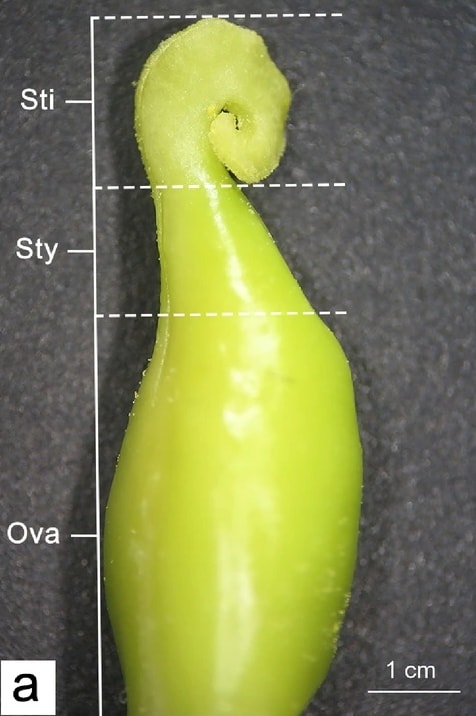
carpel: an organ at the centre of a flower, bearing one or more ovules and having its margins fused together or with other carpels to enclose the ovule in an ovary, and consisting also of a stigma and usually a style.
[caption id="attachment_29279" align="alignleft" width="476"]
Carpel of P. ludlowii, showing ovary, style and stigma[/caption]
stamen: one of the male organs of a flower, consisting typically of a stalk (filament) and a pollen-bearing portion (anther)
(of the ovary of a flower) situated above the sepals and petals
(officinalis Rubra Plena x coriacea) Glaucous blue-green foliage, veins very dark, flowers black purple maroon.
F3 Single, near white, lasting flowers. Stigmas crimson. There is a touch of red in petals. This is a third generation (F3) seedling.
18". Single. Small flowers white edged with bright pink. Tops of pistils are red, stems of stamens are red. Plant dense, big leaves.
anther: pollen-bearing structure in the stamen (male organ) of the flower usually located on top of the filament of the stamen
The pollen-receptive surface of a carpel, usually sticky. It sits above the ovary on the style.
Single bright red. Very early. Dwarf, 12 inches. Cross of officinalis Otto Froebel x Tenuifolia, single. Seedling # 32-R-3.
Parentage P01898 (an APS seedling) X Salmon Dream. Semi-double hybrid. First bloomed 1999. Dark maroon red. Good substance, stamens, pollen, seeds, one to three buds per stem. An easy bloomer, 30" with adequate stems, midseason bloom, above average vigor
Very dark red Jap. Good upright grower, vigorous, late, 34 inches. An improvement on Fuyajo. Seedling # JE-3.
Award of Landscape Merit (ALM) description: 'Charm' (Franklin, 1931) Lactiflora Group, Late mid-season, 38? — A lustrous and satiny, dark red Japanese form bloom with a center of the same red petaloids, etched yellow. Stiff and relatively straight stems angle outward gracefully to form a very large, harmoniously mounded, fountain of blooms. An eight-year-old plant matures to 40 or so stems that emerge from a relatively compact area. Although individual blooms are at their peak for a shorter duration than those of other lactifloras, plenty of side buds help 'Charm' maintain its striking presence in the landscape. One of the later Japanese form peonies to bloom.
Officinalis x lactiflora. Single, early red. Seedling A1A77, second generation Otto Frobel hybrid. This is a very remarkable, small, black single which is a second generation hybrid as stated above and was displayed at the Milwaukee, Wis., show in 1944. M
Seedling TF-8. Parentage: (P. tenuifolia 'Plena' x P. tenuifolia 'Rosea')F2. First bloomed 2012, first propagated 2013. Fully double BOMB form. Baby pink flowers are borne 1 to a stem, 3¼ inches (8 cm) in size, up facing to slightly out facing. Two to three carpels on average which are glabrous to slightly tomentose, green and topped with whitish stigmas, the latter sometimes deformed. Disc poorly developed. No pollen, but as a pod parent normally fertile but not with other pink P. tenuifolia, so far. Not fragrant. Blooming time very early, together with or slightly ahead of P. tenuifolia 'Plena'. Finely cut foliage, pale green on emergence, is typical of the species. Average height to 15 inches (38 cm); support not needed. Named after originator's mother who was not the tallest person but the best mother one can imagine.
From these last series, they've received a long warm period and will now go into cold storage. Here the two…
Worked like a charm this time. Rooted seeds of nearly all 'difficult' samples and almost all of them looking perfectly…
Updated with some more info I received from Aleksej.
OF never makes good carpals at my house, so the method I used was to use OF as a pollen…
I haven't followed up on it and I don't grow any of them myself. You're right to ask for it…
Any further information on Little Erna…it’s been 7 years.
I must say that I grow all my seedlings in potting soil, 24 seeds to a #3 pot. I keep…
I can't speak much about the "stimulating" properties of any of these products, but my sense is that the bacterial…
Danke für den interessanten Artikel. Werde ich auch mal anwenden für Spezies-Sämlinge und Jungpflanzen von Albiflora . Ich hoffe es…
Yes. But I'll have to admit that I haven't done a decent trial comparing seeds treated with GA3 and a…