Peonies in China and the Netherlands
From: Neefjes, H. ” Chinese people are crazy about peonies.” In: Greenity, number 212, Dec 12, 2025, pp. 28-29.
Chinese people are crazy about peonies. Gijs Laan, a CNB representative specializing in peonies, estimates that the Chinese buy at least 40% of Dutch peony roots. Maybe it’s even half; he has to rely on estimates shared by importers and growers. Laan was one of the speakers at the Peony Meeting of the CNB cooperative in its auction hall in Bovenkarspel on Thursday, November 20.
It became clear in the presentation by Tricia van der Borg of Biobulb that China imported two million roots from the Netherlands in 2024. This year, the estimate was double that. As a trade agent, Van der Borg has extensive knowledge of the Chinese market but had to cancel at the last minute for private reasons. CNB representative Gijs Laan guided attendees through her comprehensive PowerPoint presentation. This presentation also indicated that relaxed regulations surrounding land use and more accessible bank loans explain the increased import of peony roots.
The expectation for 2026 was also reported: a significant drop in import demand because China’s own peony production is increasing rapidly. About 60% of the purchased peonies are intended for propagation (through root divisions and seed) and sale in the following years. This concerns the more expensive segment, where the root is preferably fresh, two years old, healthy, true to type, and has 3 to 5 ‘eyes’ (buds). The lower-priced roots, about 25% of the import volume, are used for cut flowers and pot growers, as well as for planting in parks. The remaining part of the purchased roots is raw material for medicines, tea, liqueur, and oil.
HIGH-REWARD GAMBLE
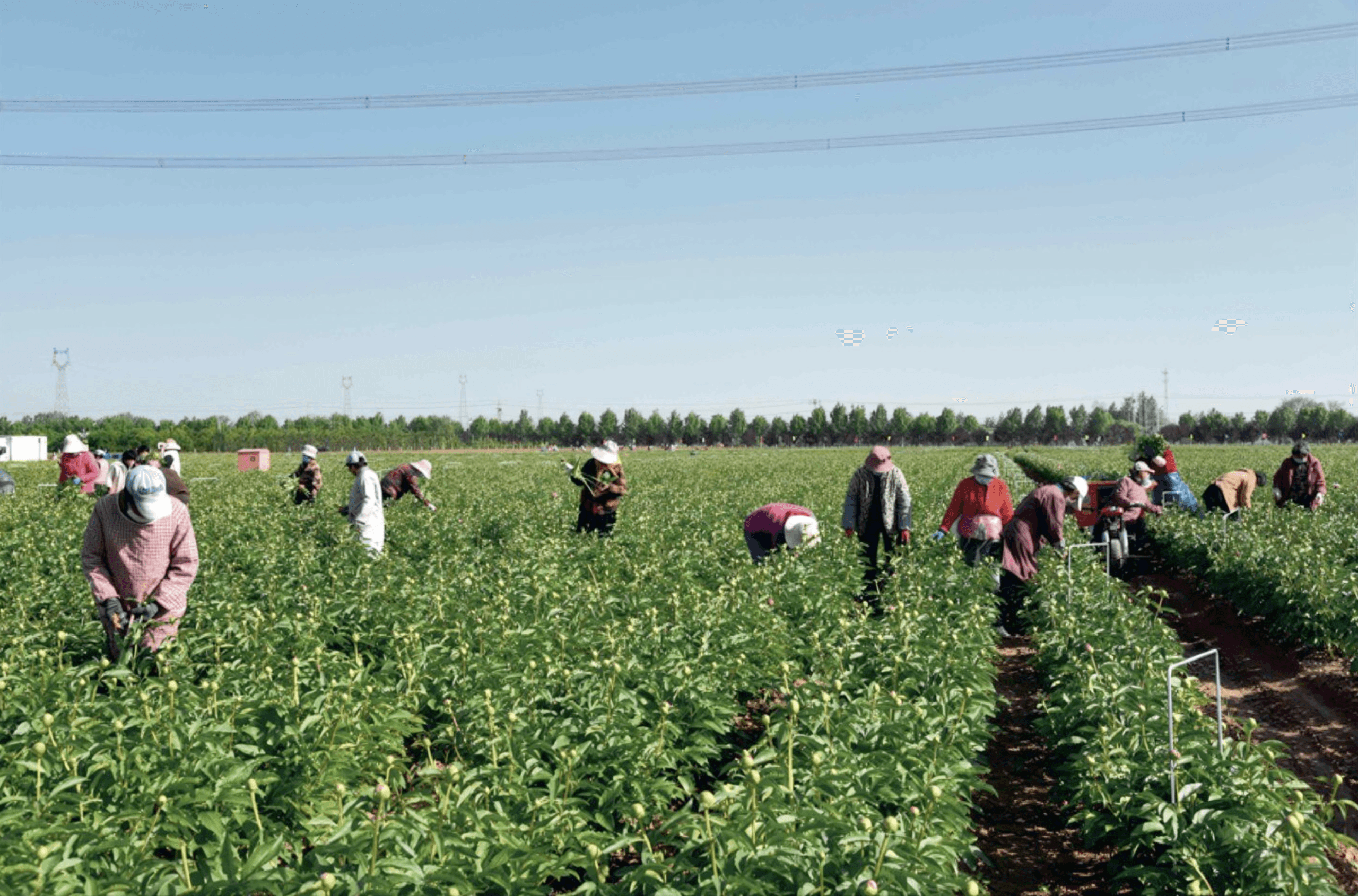
Professional importers of starting material for horticulture are by far the main buyers of peony roots (75% of the volume) , but there are also ‘fortune seekers’ and growers’ associations who buy. In Shandong province, near the city of Heze, the largest production area for peonies in China is located, spanning 3,300 hectares (=8,250 acres). Families around the more than 260 cultivation companies there encourage each other to start growing this crop. Growers see it as a high-risk, high-reward gamble. They discuss it in special WeChat groups. One of the largest buyers has only been in this business for 3-4 years, noted Van der Borg. The preference is for light pink, two-toned (white and pink), double, or new cultivars. The Chinese already cultivate varieties like Bartzella, Blush Queen, Bowl of Cream, Command Performance, Red Charm, Sarah Bernhardt and its mutants, and Sunny Girl. Because domestic production is increasing rapidly, competition in the market is increasing, and the domestic roots price is falling. Choosing reliable buyers is the advice given to the Dutch peony sector. What remains popular is uncertain. Crop failures due to heavy rainfall will slow down expansion , but ultimately, China is expected to cause an oversupply of peonies on the world market.
FLOWERS ARE POPULAR
Based on information from growers, approximately 40 to 50 million stems were cut in Shandong province in 2025. Currently, these cut flowers are mainly for the domestic Chinese market. They are pre-ordered via e-commerce platforms or sold via livestreaming hosts. Not only the Chinese love peonies. Day chairman Aad Vernooy reported that the flower is playing an increasingly important role during exclusive events and weddings in the Middle East. Mark Jansen of trading company EZ Flower shared his expertise on the flower trade to America at the meeting. Peonies are a highly requested product among his customers almost year-round. He buys them hardly from China, but rather from Israel, Chile, France, and the Netherlands. The growing demand for exclusive varieties and large flowers is particularly striking, according to Jansen. His tip to growers was to cut them at stage 2-3. (Download the harvest stages, pdf))
Gijs Laan briefly touched upon Dutch flower production in the past season in his own presentation. The number of harvested stems was significantly higher than in 2024, when the harvest was disappointing because the period preceding that harvest was very wet. Inquiries at Royal FloraHolland reveal that the auction traded over 100 million peonies this year. The average price was 0,62 Euro (0,72 US$) per stem. A year earlier, it involved 75 million stems, and the average price was 0,74 Euro (0,86 US$).
TISSUE CULTURE
Pre-sales of roots are easier this year, according to Laan. The quality and size of the roots deserve great attention from growers, in his view. This applies both to common varieties, which are worth €1.50 (1.75 US$) per root in size 3-5, and to the more exclusive assortment, where a ‘Pastelegance’ can fetch up to € 80 (92 US$) per root. The propagation of peonies is done via root division. Scaling up is much faster via tissue culture. “In 3-4 years, you can make 30,000 plants from 1 plant,” said Wim Gutter of the company Iribov. Their lab has protocols for propagating various peony varieties in the lab, but for now, they are doing it on a limited scale and mainly with tree peonies and Itoh peonies. Some tissue culture trials have been carried out together with growers for the cultivar Sarah Bernhardt and some hybrid varieties. Subsequent cultivation in the open ground showed varying growth and flowering results. Gutter mentioned that supplied base material of peony increasingly contains tobacco rattle virus. This can be purified via meristem culture, Gutter told the over 200 visitors, including many growers who produce peony flowers or roots.
TIPS FOR GROWERS
Practical tips for the growers in the hall came from advisor Jeroen Groot of Agrifirm-GMN and Jan Ties Malda, product manager at Cebeco Agro. For tackling grasses in cultivation, the systemic contact herbicide Agil (a.i. propaquizafop) is an excellent option, Groot indicated in his presentation. As an alternative to the fungicide Luna (a.i. fluopyram), which will be withdrawn from the market around mid-2026, he mentioned, among others, the new product Hokonza (a.i. benzovindiflupyr) and phosphonates. In a trial with flowers stored in the cold room for seven weeks after harvest, the commonly used treatment scheme achieved the best results. However, comparable results can be achieved with new products, Groot learned. “Gain experience with new products, because Luna is not the only one that will disappear,” was his advice. In a 3-year cultivation trial with the cultivar Sarah Bernhardt, Groot observed that organic DCM fertilizers gave a comparable result to standard fertilization. Not much is known yet about the effect of biostimulants in peonies, said Jan Ties Malda of Cebeco Agro. Together with Agrifirm, he is testing some products that have proven effective in other crops. Soil-Set, for example, is used in the bulb cultivation of lily and hyacinth. It promotes rooting and root growth, which ultimately leads to a more vital crop. “Dip the peony cuttings before planting,” Malda advised as a tip. “And test with your advisor what role a biostimulant can have in your cultivation scheme. Be aware that effects can even differ per cultivar. The goal should be: a strong and affordable scheme.”