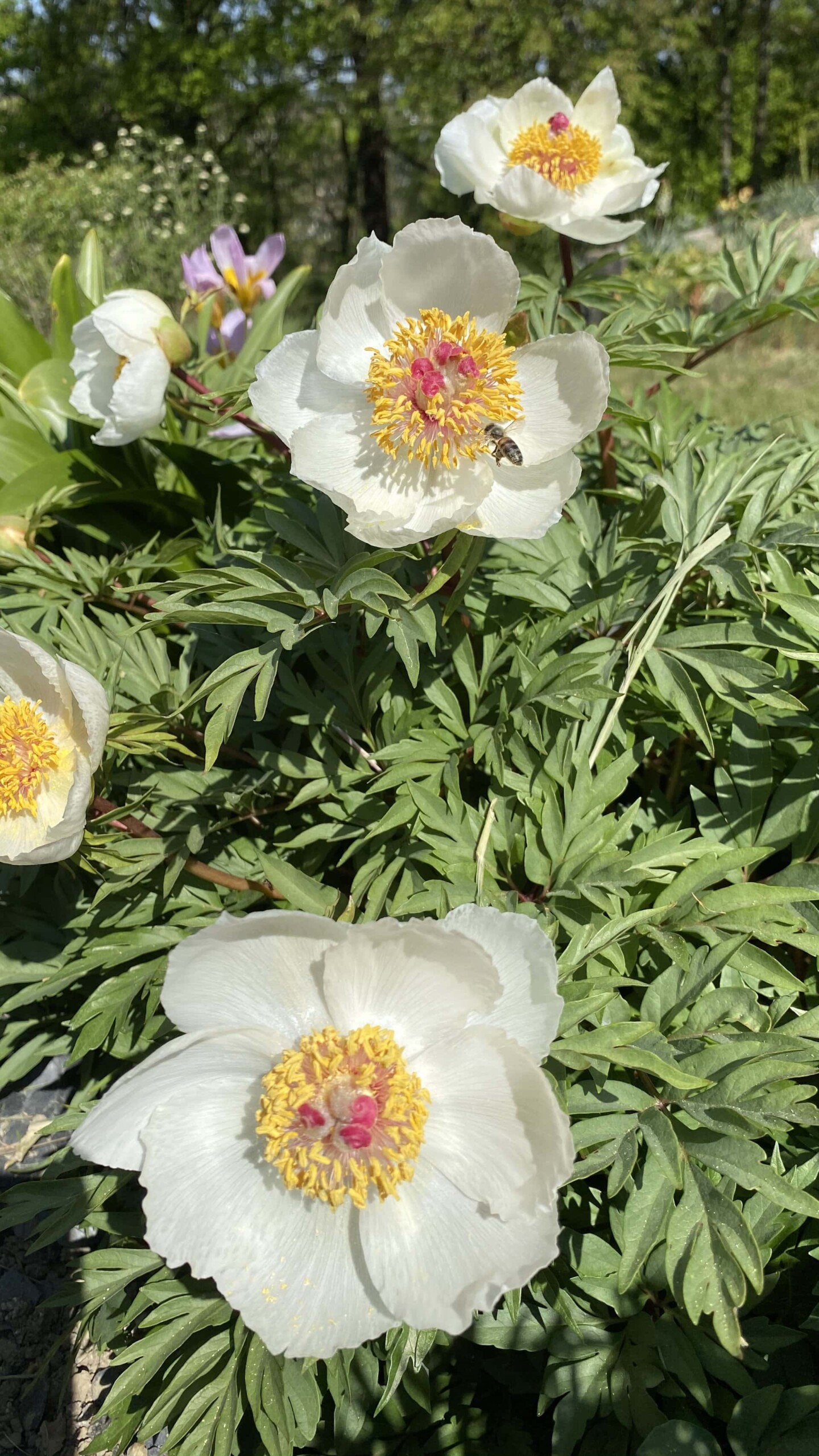
Paeonia clusii ssp clusii
Additional information about this plant:
20 years old
Date added to the SPIN database:
Plant number:
31773
Origin of this plant:
(A) Grown from wild collected seeds or a plant collected in nature (a "true" species plant)
State of this plant:
Mature plant
Resemblance of this plant to the average of the species:
Fully accurate
Some more info about the SPIN member growing this plant:
We are sorry, this SPIN member has not yet filled out more general information about his plants.
If this plant is linked to a member of this website, you can contact him through his profile which you can find at the beginning of the plant’s description.
All species plants of this SPIN member:
20 years old
Origin:
(A) Grown from wild collected seeds or a plant collected in nature (a "true" species plant)
Plant number:
31773
From these last series, they've received a long warm period and will now go into cold storage. Here the two…
Worked like a <a class="wpg-linkify wpg-tooltip" title="<div class="wpg-tooltip-content"><p>Very dark red Jap. Good upright grower, vigorous, late, 34 inches. An improvement on Fuyajo. Seedling # JE-3.</p>
<p>Award of Landscape Merit (ALM) description: 'Charm' (Franklin, 1931) Lactiflora Group, Late mid-season, 38? — A lustrous and satiny, dark red Japanese form bloom with a center of the same red petaloids, etched yellow. Stiff and relatively straight stems angle outward gracefully to form a very large, harmoniously mounded, fountain of blooms. An eight-year-old plant matures to 40 or so stems that emerge from a relatively compact area. Although individual blooms are at their peak for a shorter duration than those of other lactifloras, plenty of side buds help 'Charm' maintain its striking presence in the landscape. One of the later Japanese form peonies to bloom.</p>
</div>" href="https://www.peonysociety.org/registered_peonies/charm/" >charm</a> this time. Rooted seeds of nearly all 'difficult' samples and almost all of them looking perfectly…
Updated with some more info I received from Aleksej.
OF never makes good carpals at my house, so the method I used was to use OF as a pollen…
I haven't followed up on it and I don't grow any of them myself. You're right to ask for it…
Any further information on &amp;amp;amp;lt;a class=&amp;amp;amp;quot;wpg-linkify wpg-tooltip&amp;amp;amp;quot; title=&amp;amp;amp;quot;&amp;amp;amp;amp;lt;div class=&amp;amp;amp;amp;quot;wpg-tooltip-content&amp;amp;amp;amp;quot;&amp;amp;amp;amp;gt;&amp;amp;amp;amp;lt;p&amp;amp;amp;amp;gt;Seedling TF-8. Parentage: (P. tenuifolia &amp;amp;amp;amp;#039;Plena&amp;amp;amp;amp;#039; x P. tenuifolia &amp;amp;amp;amp;#039;Rosea&amp;amp;amp;amp;#039;)F2. First bloomed 2012, first propagated 2013. Fully double BOMB form. Baby pink flowers are borne 1 to a stem, 3¼ inches (8 cm) in size, up facing to slightly out facing. Two to three <a class="wpg-linkify wpg-tooltip" title="&lt;div class=&quot;wpg-tooltip-content&quot;&gt;&lt;p&gt;carpel: an organ at the centre of a flower, bearing one or more ovules and having its margins fused together or with other carpels to enclose the <a class="wpg-linkify wpg-tooltip" title="<div class="wpg-tooltip-content"><p>a part inside the ovary (= organ that produces eggs) of a plant that contains the female sex cell and develops into a seed when that cell is fertilized</p>
</div>" href="https://www.peonysociety.org/registered_peonies/ovule/" >ovule</a> in an <a class="wpg-linkify wpg-tooltip" title="<div class="wpg-tooltip-content"><p>the hollow base of the carpel of a flower, containing one or more ovules</p>
</div>" href="https://www.peonysociety.org/registered_peonies/ovary/" >ovary</a>, and consisting also of a <a class="wpg-linkify wpg-tooltip" title="<div class="wpg-tooltip-content"><p>The pollen-receptive surface of a carpel, usually sticky. It sits above the ovary on the style.</p>
</div>" href="https://www.peonysociety.org/registered_peonies/stigma/" >stigma</a> and usually a style.&lt;/p&gt;
&lt;p&gt;&lt;/p&gt;
&lt;/div&gt;" href="https://www.peonysociety.org/registered_peonies/carpels/" >carpels</a> on average which are &lt;a class=&quot;wpg-linkify wpg-tooltip&quot; title=&quot;&amp;lt;div class=&amp;quot;wpg-tooltip-content&amp;quot;&amp;gt;&amp;lt;p&amp;gt;Without hairs.&amp;lt;/p&amp;gt;
&amp;lt;/div&amp;gt;&quot; href=&quot;https://www.peonysociety.org/registered_peonies/glabrous/&quot; &gt;glabrous&lt;/a&gt; to slightly &lt;a class=&quot;wpg-linkify wpg-tooltip&quot; title=&quot;&amp;lt;div class=&amp;quot;wpg-tooltip-content&amp;quot;&amp;gt;&amp;lt;p&amp;gt;Covered with dull colored woolly hairs. Short and entirely covering the ovaries. Found in most peony species.&amp;lt;/p&amp;gt;
&amp;lt;/div&amp;gt;&quot; href=&quot;https://www.peonysociety.org/registered_peonies/tomentose/&quot; &gt;tomentose&lt;/a&gt;, green and topped with whitish <a class="wpg-linkify wpg-tooltip" title="&lt;div class=&quot;wpg-tooltip-content&quot;&gt;&lt;p&gt;<a class="wpg-linkify wpg-tooltip" title="<div class="wpg-tooltip-content"><p>The pollen-receptive surface of a carpel, usually sticky. It sits above the ovary on the style.</p>
</div>" href="https://www.peonysociety.org/registered_peonies/stigma/" >Stigma</a>: the pollen-receptive surface of a carpel or group of fused carpels, usually sticky.&lt;/p&gt;
&lt;p&gt;&lt;/p&gt;
&lt;/div&gt;" href="https://www.peonysociety.org/registered_peonies/stigmas/" >stigmas</a>, the latter sometimes deformed. Disc poorly developed. No pollen, but as a pod parent normally fertile but not with other pink P. tenuifolia, so far. Not fragrant. Blooming time very early, together with or slightly ahead of P. tenuifolia &amp;amp;amp;amp;#039;Plena&amp;amp;amp;amp;#039;. Finely cut foliage, pale green on emergence, is typical of the species. Average height to 15 inches (38 cm); support not needed. Named after originator&amp;amp;amp;amp;#039;s mother who was not the tallest person but the best mother one can imagine.&amp;amp;amp;amp;lt;/p&amp;amp;amp;amp;gt;
&amp;amp;amp;amp;lt;/div&amp;amp;amp;amp;gt;&amp;amp;amp;quot; href=&amp;amp;amp;quot;https://www.peonysociety.org/registered_peonies/little-erna/&amp;amp;amp;quot; &amp;amp;amp;gt;Little Erna&amp;amp;amp;lt;/a&amp;amp;amp;gt;…it’s been 7 years.
I must say that I grow all my seedlings in potting soil, 24 seeds to a #3 pot. I keep…
I can't speak much about the &amp;amp;amp;amp;amp;amp;amp;amp;amp;quot;stimulating&amp;amp;amp;amp;amp;amp;amp;amp;amp;quot; properties of any of these products, but my sense is that the bacterial…
Danke für den interessanten Artikel. Werde ich auch mal anwenden für Spezies-Sämlinge und Jungpflanzen von Albiflora . Ich hoffe es…
Yes. But I'll have to admit that I haven't done a decent trial comparing seeds treated with GA3 and a…